Government Affairs Strategy: The Practitioner’s Guide to Power, Risk, and Influence.
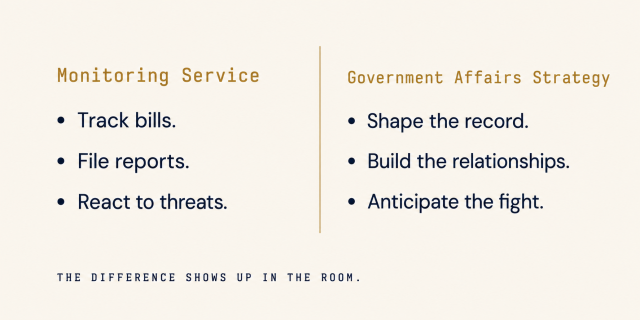
Most organizations have government affairs functions. Very few have government affairs strategies. The difference determines whether you shape outcomes or react to them — and it shows up in the room before anyone says a word.
The Uncomfortable Truth About Government Affairs
Let me tell you what most government affairs strategy actually is.
It is a list of bills to track. A spreadsheet of legislative contacts. A quarterly report to the executive team summarizing what happened in the statehouse. A lobbyist retained in three states. A sign-on letter assembled when something threatening appears on the horizon.
Real government affairs strategy is something different — and the organizations that have figured out the difference are consistently better positioned when the moments that actually matter arrive. They are in the room before the fight starts. They have relationships that were built before they needed them. They understand the mechanics of how decisions get made well enough to anticipate what is coming rather than reacting to what has arrived.
This guide is the framework. Not the consultant’s version. Not the software vendor’s version. The practitioner’s version — built from direct experience in the room where these decisions actually happen.
What Government Affairs Strategy Actually Is
Government affairs strategy is an organization’s deliberate, sustained effort to understand, navigate, and influence the government environments that affect its operating conditions — before those environments create crises.
That definition has four operative words worth unpacking.
Deliberate
Planned, resourced, and maintained regardless of whether a specific threat is visible. The organizations that only activate their government affairs function when something threatens them are always playing catch-up. By the time the threat is visible, the record is already being written by someone else.
Sustained
Year-round, not session-round. The relationships that are useful when a bill is moving are built in the months when nothing is moving. The commissioner whose vote you need in a rate case proceeding needs to know who you are before the proceeding starts, not after you file.
Understand
Comes before influence. This is the part most organizations skip. They deploy lobbying resources before they have done the intelligence work to understand what the relevant legislators actually care about, what the commission staff is worried about, who the intervenors will be. They walk into rooms with arguments constructed for a situation that does not exist.
Before
This is the entire game. Government affairs that operates before decisions are made shapes those decisions. Government affairs that operates after decisions are made is damage control.
The Four Arenas of Government Affairs Power
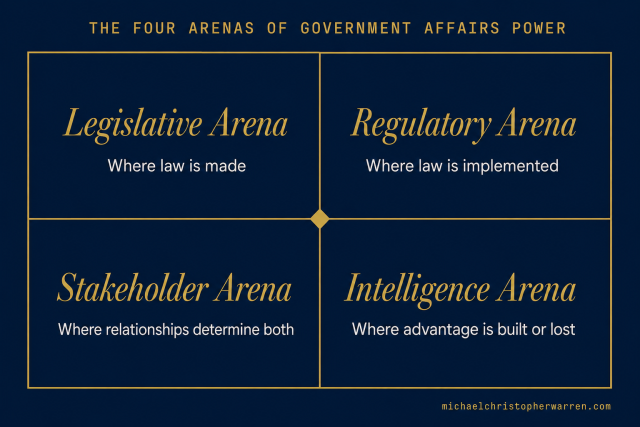
Legislative · Regulatory · Stakeholder · Intelligence
The Four Arenas of Government Affairs Power
Every government affairs challenge — regardless of industry, geography, or issue — plays out across four arenas simultaneously. The organizations that understand all four and operate deliberately in all four are the ones that consistently produce outcomes. The ones that focus on one or two are the ones that get blindsided by what is happening in the other two.
The Legislative Arena
This is where law is made. Bills introduced, committees convened, amendments drafted, floor votes scheduled. This is where most organizations concentrate their government affairs investment — the lobbyist, the legislative monitor, the coalition assembled around a specific bill. It is necessary. It is not sufficient.
The Regulatory Arena
This is where law is implemented. Commission proceedings, rulemaking processes, agency guidance, enforcement priorities. This is where most of the consequential day-to-day decisions happen — the ones that determine what the law actually means for your organization’s operations. Regulatory proceedings are quieter than legislative fights. They are rarely on the front page. And they are where sophisticated practitioners spend significantly more of their time than the public-facing legislative arena would suggest.
The Stakeholder Arena
This is where relationships determine the outcome in both of the above. Not the relationships between your lobbyist and the legislator’s chief of staff. The relationships between the commission and the consumer advocates who file in every docket. The relationships between the governor’s office and the industry coalition that has been showing up consistently for three years. The relationships between a community organization and the legislative staff member who shapes what the committee actually considers. Stakeholder strategy is not stakeholder engagement. It is the deliberate mapping and cultivation of the relationships that influence decision-makers across both the legislative and regulatory arenas.
The Intelligence Arena
This is where advantage is built or lost before anyone walks into the other three rooms. What are the commissioners actually worried about? What arguments will the intervenors make? What does the governor’s office consider a political win or loss on this issue? What is the evidentiary record showing that nobody in the room has actually read? The organizations that operate on primary source intelligence — that read the actual dockets, the actual transcripts, the actual filings — hold decisive advantage over everyone operating on briefings and summaries. This is not a marginal advantage. In contested proceedings and legislative fights, it is often the whole game.
What Separates Strategic Programs From Reactive Ones
The 2025 Quorum State of Government Affairs survey found that 44.9% of government affairs programs now describe themselves as strategic. That means more than half still do not. And even among the 45% who claim the label, the actual operating practices suggest the number is generous.
Here is what separates programs that are genuinely strategic from those that are reactive with better branding.
| Reactive Program | Strategic Program | |
| INFORMATION | Reads the news | Reads the primary source |
| RELATIONSHIPS | Builds when needed | Builds year-round |
| RECORD | Reacts to it | Shapes it |
| TIMING | Mobilizes after the threat | Positions before the fight |
| OUTCOMES | Damage control | Decisive advantage |
“By the time the reactive program is mobilizing, the strategic program has already written the first draft of the record.”
The Government Affairs Strategy Framework
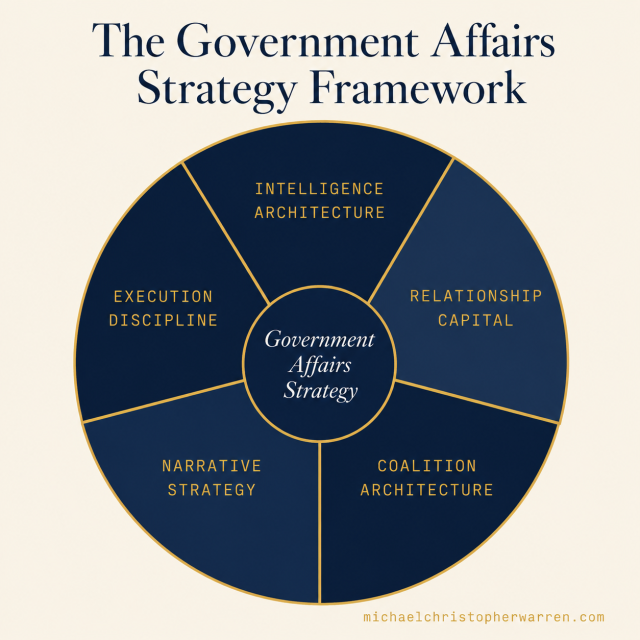
A government affairs strategy is not a document. It is an operating system. It has five components that work together — and the absence of any one of them creates a gap that the other four cannot close.
Intelligence Architecture
Before strategy comes intelligence. What is the legislative environment in your primary operating states? Who are the commissioners, what are their priorities, and what has their voting record in contested proceedings revealed about where they will land on your issues? Who are the intervenors that will participate in your next docket and what arguments will they make? Intelligence architecture means having a systematic, primary-source approach to answering these questions before you need them.
Relationship Capital
Relationship capital is the asset that government affairs programs build or fail to build over time — and unlike financial capital, it cannot be acquired quickly when you need it. The most valuable relationships in government affairs are the ones that exist before there is anything specific to ask for. Building relationship capital requires year-round presence, consistent usefulness, and the willingness to show up with information and context even when there is no immediate ask.
Coalition Architecture
A coalition is not a list of supporters. It is a group of independent actors who have their own reasons to advance the same outcome you need. Real coalition partners file their own comments. They have their own conversations with decision-makers. They apply pressure from angles you did not coordinate and could not occupy yourself. Building that kind of coalition requires understanding who else needs your outcome and why — which requires the intelligence architecture described above.
Narrative Strategy
Decision-makers are not persuaded by the strongest technical argument. They are persuaded by the argument that fits the narrative frame they are already operating within. A commissioner worried about ratepayer protection will process your cost recovery argument through that frame. Narrative strategy means understanding the frames your key decision-makers use and constructing your arguments to align with those frames. The organizations that walk into commission proceedings talking about jobs, investment, and innovation — and wonder why the commission is not persuaded — have not done the narrative strategy work.
Execution Discipline
Strategy without execution is a document. Execution discipline means the year-round calendar that keeps relationship capital from depreciating, the monitoring system that surfaces relevant intelligence before it becomes a crisis, the internal processes that connect your government affairs intelligence to the business decisions it should be informing, and the evaluation framework that tells you whether any of it is working.
The State-Level Shift Every Organization Needs to Understand
There is a structural change underway in American government affairs that most organizations have not fully accounted for in their strategy.
The action has moved to the states.
The 2025 Quorum State of Government Affairs survey found that 75% of government affairs programs now target state legislatures as a primary focus — edging out federal engagement at 69.2%. That gap will continue to widen. The policy decisions that determine what your organization can do, what it must pay, and what it must disclose are increasingly being made in state capitals rather than Washington.
This is structural, not cyclical. Congressional gridlock on virtually every major policy area has persisted long enough that states have filled the vacuum with their own frameworks — on healthcare, on technology regulation, on energy and climate, on data privacy, on employment law. The government affairs programs that have not recalibrated their resource allocation to reflect this reality are carrying risk they cannot see from their DC-centric vantage point.
How to Assess Your Government Affairs Program’s Current State
The following questions are not a formal audit. They are the questions a senior practitioner would ask after spending thirty minutes reviewing your government affairs operation. If you are honest with yourself, the answers will tell you exactly where the gaps are.
ON INTELLIGENCE
When did someone in your organization last read an actual commission order or legislative committee transcript — not a summary of one — in a jurisdiction that affects your operations? If the answer is “not recently” or “never,” you are operating on secondhand information in situations where that information asymmetry has real consequences.
ON RELATIONSHIPS
If you had to call the three people in the relevant state agency or commission whose opinions matter most to your issues right now — not to ask for anything, just to have a productive conversation — would they know who you are? Would they take the call?
ON COALITION
If you stopped organizing your coalition tomorrow, which of your current “partners” would continue to show up in proceedings and legislative conversations? The ones who would are your real coalition. The ones who would not are your audience.
ON NARRATIVE
Can you articulate, in the specific language your key decision-makers use, why your organization’s position is good for the things they care most about — not what you care most about, what they care most about? If you have to think about it for more than thirty seconds, you have not done the narrative work.
ON EXECUTION
Is your government affairs function integrated into your organization’s strategic planning, capital deployment decisions, and operational planning — or does it get consulted when something goes wrong? The answer to that question describes exactly how much influence you actually have.
The External Affairs Maturity Model
Most government affairs programs move through a recognizable progression. Understanding where your program sits on this progression — and what specifically separates each level — is the first step toward moving up it.
Government affairs exists in name, not in practice. Issues are addressed when they become crises. There is no systematic monitoring, no dedicated relationship building, no intelligence infrastructure. The program responds when the phone rings.
The program monitors legislative and regulatory activity and responds to threats. Lobbyists are retained. Coalitions are assembled around specific bills or proceedings. Resources are consistently deployed too late to shape the record.
The program anticipates developments and positions in advance of legislative sessions and regulatory proceedings. Relationships are maintained year-round. The coalition has some genuine independence. Primary source intelligence is used, though not systematically.
All five components of the strategy framework are operational. Intelligence architecture is systematic. Relationship capital is actively managed. Coalition partners act independently. Narrative strategy is informed by genuine understanding of what decision-makers care about. Execution is disciplined and integrated into organizational planning.
The program operates from a proprietary intelligence advantage. Primary source intelligence is systematically gathered, analyzed, and deployed across all four arenas. The program shapes the record before proceedings begin. Coalition partners are identified and activated through intelligence work. The government affairs function is integrated into capital deployment decisions, market entry strategy, and operational planning.
Where to Go From Here
Government affairs strategy is not a one-time exercise. It is a discipline — practiced consistently, refined through experience, and compounded over time. The organizations that build genuine strategic capability in this area do not get there through a single initiative. They get there through the accumulation of deliberate choices: to read the primary source instead of the summary, to show up in the off-season when nothing is urgent, to build the coalition before they need it, to understand the commissioner’s priorities before they file.
The frameworks in this guide are the architecture. The practice is up to you.
For practitioners who work in or adjacent to the utility regulatory space, RegulatorIndex provides the intelligence infrastructure that makes Level 5 government affairs strategy operationally feasible — systematic access to commission proceedings, commissioner profiles, and docket activity across all fifty states.
For organizations navigating a specific government affairs challenge, the consulting engagements outlined here are the direct engagement model.
Michael-Christopher Warren
Government affairs and external affairs professional. Founder of RegulatorIndex.com — a practitioner-built intelligence platform mapping every U.S. Public Utility Commission for the professionals who can’t afford secondhand analysis. He writes at michaelchristopherwarren.com and publishes PUC Watch, a bi-weekly intelligence briefing on U.S. utility regulation.
RegulatorIndex.com →