Public Utility Commission Intelligence: The Practitioner’s Guide.
There are 50 state public utility commissions in the United States. Most practitioners access them through clunky websites, arcane docket systems, and secondhand summaries. The practitioners who access them directly hold an advantage that no briefing document can replicate.
Why Public Utility Commissions Are the Most Underestimated Regulatory Bodies in America
Ask a government affairs professional at a major technology company to name the regulatory bodies that most affect their organization’s operating environment. They will name the FTC. The FCC. The FTC again. SEC if there is a financial services dimension. State attorneys general if they are sophisticated.
Very few will name the public utility commissions.
That is an expensive blind spot — and it is getting more expensive every quarter.
State public utility commissions are quasi-judicial bodies that regulate the utilities providing electricity, natural gas, water, and telecommunications services in their jurisdictions. In regulated markets they set the rates utilities charge customers, approve infrastructure investments, determine cost allocation methodologies, and make the decisions that determine whether a data center gets power, at what price, on what timeline, and under what contractual terms.
They do all of this in proceedings that are formally public but practically inaccessible — hidden, as NYU’s Center for Social Media and Politics noted in a November 2025 report, behind clunky websites, obtuse proceeding names, and arcane rules. The proceedings are public record. Most practitioners never read them.
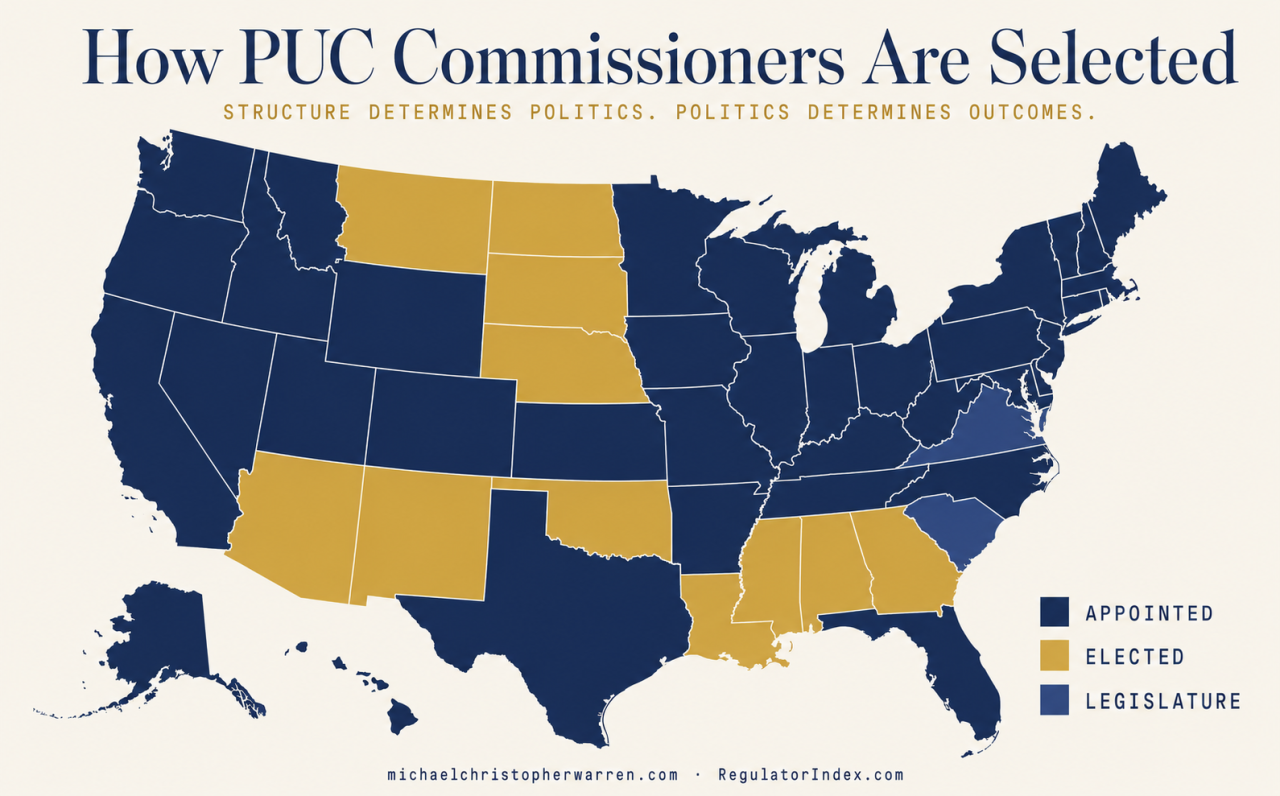
Most states have a PUC made up of three to five commissioners serving four to six year terms. Thirty-six states give the governor appointment authority. Two states — Virginia and South Carolina — place appointment in the legislature’s hands. The remaining states use elections. The governance structure varies. The power to determine your organization’s operating costs, infrastructure access, and competitive position does not.
This guide is the practitioner’s map of the PUC landscape — what these bodies are, how they actually work, what the intelligence is that matters, and how to access it before your competitors do. It is the foundation that RegulatorIndex was built to support and that PUC Watch was built to deliver.
What a Public Utility Commission Actually Does
The textbook answer is that PUCs regulate utilities to ensure safe, reliable, affordable, and environmentally responsible service. That is accurate and almost completely useless as a practitioner framework.
Here is the practitioner answer: a PUC is an institution that resolves contested questions about who pays for what in a regulated utility system. Every significant decision a commission makes — a rate case order, a cost allocation methodology, a large load tariff, an infrastructure approval — is ultimately an answer to that question. Understanding a commission means understanding how it has historically answered it, how it is likely to answer it under current political conditions, and where its answer is vulnerable to being changed by the parties who show up in the proceeding.
The Regulatory Intelligence Loop
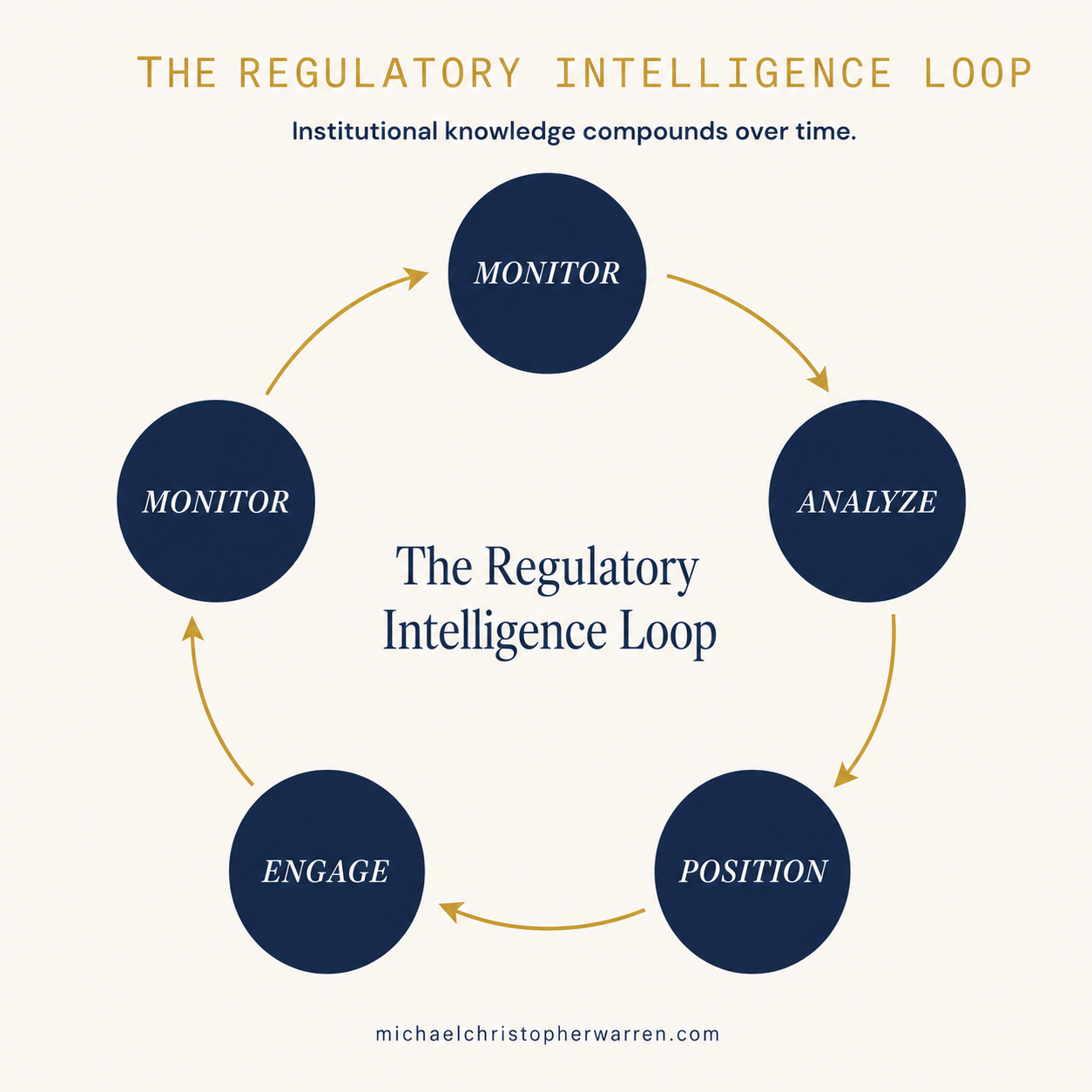
Monitor → Analyze → Position → Engage → Monitor
The PUC’s formal functions fall into five categories that every practitioner needs to understand before walking into a proceeding or advising a client on one.
Rate Setting
The commission determines what the utility can charge customers for service. Rate cases are the primary vehicle for this — complex, contested proceedings that can run eighteen months or longer and involve testimony from utilities, consumer advocates, large commercial customers, environmental groups, and commission staff. The rate case order determines the economics of the utility’s operations for the next several years.
Infrastructure Approval
Major capital investments — new transmission lines, generation additions, grid modernization programs — require commission approval before a utility can recover their costs from ratepayers. This is where infrastructure developers, technology companies, and energy investors collide with commission proceedings whether they intend to or not. If your project requires utility infrastructure, the commission will have opinions about who pays for it.
Cost Allocation
Who pays for shared infrastructure? How are the costs of grid modernization distributed across customer classes? When a large new load — a data center, a manufacturing facility, a new commercial development — requires significant infrastructure investment, the commission decides whether that customer pays, whether existing ratepayers absorb the cost, or whether costs are shared and in what proportion. This is the fight that is consuming commissions from Virginia to California right now.
Service Quality and Reliability
Commissions set performance standards for utilities — outage response times, customer service metrics, safety requirements. These standards are increasingly consequential as grid reliability becomes a political issue tied to extreme weather events, wildfire risk, and the power demands of AI infrastructure. A commission that has been publicly embarrassed by utility performance failures is a commission that is building a more adversarial record toward the utility in future proceedings.
Policy Implementation
State legislatures pass clean energy mandates, set emissions targets, and establish energy policy frameworks. PUCs implement them — translating statutory language into operational requirements, cost recovery mechanisms, and procurement obligations. The gap between what a clean energy mandate says and what a commission decides it means is often large and always consequential. The practitioner who understands both reads the statute and the commission’s implementation orders.
Public Utility Commission Intelligence That Actually Matters — And Where to Find It
Most practitioners who interact with PUC proceedings do so through one of three channels: their lobbyist’s update call, the trade press summary, or the utility’s own briefing about what happened in a hearing. All three of these are useful. None of them are sufficient for serious strategic positioning.
The intelligence that actually matters in PUC proceedings is in the primary sources — and it is divided into four categories that require different reading strategies and yield different types of strategic value.
CATEGORY 01 — COMMISSIONER SIGNALS
What commissioners say before they decide
Commissioner statements at public hearings, technical conferences, and industry forums are the most underutilized intelligence available in PUC proceedings. Commissioners speak frequently and on the record. When a commissioner asks a utility to explain how its load forecast accounts for the possibility that a major data center tenant does not materialize — as Virginia SCC commissioners did in the Dominion proceedings — that is not a rhetorical question. It is a signal of where the condition is coming from. The practitioners who hear that signal early build their case accordingly. The ones who read about the condition in the order are building their appeal.
CATEGORY 02 — STAFF ANALYSIS
The technical analysis commissioners rely on
Commission staff analysis — filed as staff testimony, technical reports, or proposed decisions — is where the evidentiary record is actually shaped. Staff positions carry significant weight with commissioners because staff have no institutional interest in a particular outcome and are perceived as neutral analysts. In many commissions, the staff’s proposed decision is adopted with minor modifications more often than it is overruled. Understanding what staff is focused on, what their methodology is, and where they have flagged concerns is essential preparation for any contested proceeding.
CATEGORY 03 — INTERVENOR FILINGS
The opposition’s argument — before they make it in the room
Intervenor testimony and comments are public record. Consumer advocates, environmental groups, large commercial customers, and other parties file their positions in the docket — complete with the specific arguments they intend to make, the expert witnesses they are relying on, and the remedies they are seeking. A practitioner who reads intervenor filings from the last three comparable proceedings in a jurisdiction knows exactly what arguments will be deployed against their client’s position before the proceeding begins. That advance knowledge changes the entire preparation strategy.
CATEGORY 04 — COMMISSION ORDERS
The reasoning that predicts the next decision
Commission orders are the most cited and least read documents in PUC proceedings. Most practitioners read the outcome — what was approved, what was denied, what conditions were imposed. The practitioners who read the reasoning — the specific evidentiary bases the commission cited, the arguments it found persuasive versus those it acknowledged and dismissed, the language it used to describe its concerns — are the ones who understand how to construct an argument the next commission will accept. Orders are the map to the next decision. Most people only read the destination.
“Orders are the map to the next decision. Most people only read the destination.”
The Docket-to-Decision Framework
Navigating a PUC proceeding without understanding its structure is like trying to navigate a city without knowing whether you are in a grid or a radial street system. The specific rules vary by state. The underlying structure is consistent enough to map.
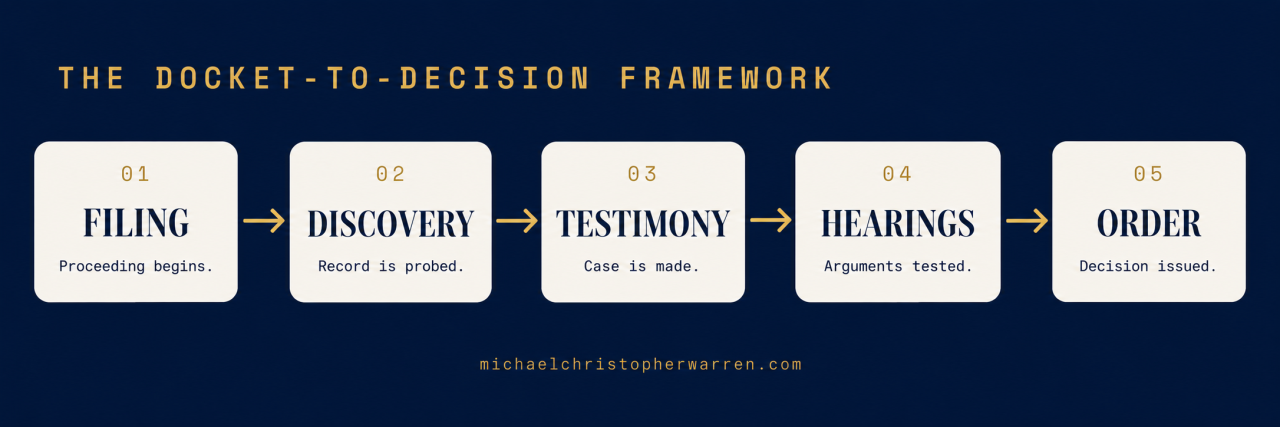
The Docket-to-Decision Framework
Primary Source → Proceeding Map → Commissioner Signals → Intervenor Positions → Record Strategy
Filing and Docketing
A proceeding begins with a filing — a rate case application, a tariff request, a petition for rulemaking. The commission dockets it, assigns a proceeding number, and establishes a procedural schedule. The procedural schedule is the calendar of the entire fight: when testimony is due, when hearings are scheduled, when the commission intends to issue its order. Experienced practitioners read the procedural schedule and work backward from the order date to plan their engagement.
Discovery and Data Requests
Intervenors can file data requests — formal questions requiring the filing party to provide documents, data, and information. The data requests that intervenors file reveal exactly what they are probing. A data request asking for the load forecast methodology underlying a utility’s infrastructure proposal is not an academic question. It is the setup for a testimony challenge. Reading the data requests filed by consumer advocates in the last three comparable proceedings tells you what the next set of data requests will target.
Testimony and Evidentiary Record
The parties file direct testimony — the expert analysis and positions that form the evidentiary record the commission will use to write its order. This is where the case is actually made or lost. A commission can only rule on what is in the record. Arguments that were not made in testimony cannot appear in the order. Practitioners who understand this shape the record proactively. Those who do not discover too late that the argument they needed was never in the record.
Hearings and Technical Conferences
Evidentiary hearings are where testimony is tested through cross-examination. Technical conferences are where commissioners and staff engage directly with parties on complex issues — and where the most valuable off-the-record signals are often transmitted. A commissioner who asks three detailed questions about load forecast credibility in a technical conference is telling you something important about where the order is heading. The practitioners in the room hear it. The ones who read the transcript three weeks later hear it with less context.
The Order and Its Aftermath
The commission’s order resolves the proceeding — but rarely finally. Orders can be appealed. Conditions can require compliance filings. Deferred questions get taken up in subsequent proceedings. Methodologies established in one order become the baseline for the next rate case. Understanding what the commission decided and why — and what it explicitly left open for future proceedings — is essential intelligence for positioning in whatever comes next.
Commissioner Intelligence — Why Personnel Is Policy
The single most underutilized intelligence asset in PUC proceedings is commissioner-level research. Most practitioners treat commissioners as interchangeable decision-makers who will apply the law neutrally. That is not how commissions work.
For any commissioner whose vote matters to your proceeding, you should know: their appointment history and who appointed them, their public statements on cost allocation, ratepayer protection, and infrastructure investment in the past 24 months, their voting record in the three most contested recent proceedings, what questions they consistently ask in technical conferences, and what arguments they have historically found compelling versus those they acknowledge and dismiss.
All of this is in the public record. RegulatorIndex is built to make it accessible. Most practitioners have never tried to find it.
Commissioner terms typically run four to six years. Thirty-six states give appointment authority to the governor. This means that every gubernatorial election is also a potential PUC election — and that the political environment of a state capital affects commission composition on a four-to-six-year lag. The practitioner who tracks commissioner terms and appointment patterns can anticipate commission shifts before they show up in orders.
The Intervenor Ecosystem — The Parties Who Will Oppose Your Next Filing
In every significant PUC proceeding, the outcome is shaped not just by what the commission decides but by what the intervenors force into the record. Consumer advocates, environmental groups, large industrial customers, attorney general offices, and competing utilities all have the right to participate — and the most experienced among them have been participating in your commission’s proceedings for longer than most corporate GR professionals have been in the field.
Understanding the intervenor ecosystem before you file is not optional if you are serious about the outcome. Here is what that understanding requires.
WHO SHOWS UP
Which organizations have participated in the last five comparable proceedings in this jurisdiction? Consumer advocates operate with roughly 10% of the staff and budget that PUCs have nationally — but the well-resourced ones are extraordinarily effective. Know who they are and whether they are resource-constrained or fully staffed before you assess the opposition you will face.
WHAT ARGUMENTS THEY RELIABLY MAKE
Intervenors are creatures of habit. The consumer advocate who challenged load forecast credibility in the last Dominion rate case will challenge load forecast credibility in the next one. The environmental group that attacked fossil fuel generation costs in the last IRP will attack them in the next one. Read their filings from comparable proceedings. The arguments are already written.
THEIR TRACK RECORD
Which intervenors have successfully imposed conditions or modifications in recent proceedings? Which ones file extensively but rarely move the commission? The difference matters for how seriously you treat their arguments and how much of your record is devoted to addressing them.
THEIR CURRENT POLITICAL MOMENTUM
Recent legislative action, funding changes, and political environment shifts affect intervenor capacity and credibility. An intervenor whose positions were recently validated by legislation has more momentum in the next commission proceeding than one operating against the political current. Tracking this is not academic — it directly affects how commissioners weigh testimony from different parties.
The Regulatory Intelligence Loop — How Serious Practitioners Stay Ahead
PUC intelligence is not a one-time research project. It is an ongoing operational discipline. The commission that approved a rate increase last year is a different commission than the one that will hear your filing next year — different political environment, potentially different commissioners, different intervenor landscape, different recent precedents shaping the record.
The practitioners who consistently outperform in commission proceedings have built what I call the Regulatory Intelligence Loop — a systematic cycle that keeps them positioned before events rather than reacting to them.
Monitor
Systematic tracking of commission activity across jurisdictions relevant to your work. New filings, commissioner appointments and departures, significant orders, technical conference announcements, legislative developments that will affect commission authority. This is not reading the trade press. This is watching the dockets.
Analyze
Reading the primary sources — not just noting that a significant order was issued but understanding what the commission said, how it reasoned, what it found persuasive, and what it left open. Commissioner signals during technical conferences. Staff analysis methodology. Intervenor argument patterns. Building the institutional knowledge of the commission that makes everything else possible.
Position
Translating the intelligence into strategic positioning — what arguments to lead with, what evidentiary support to build, how to frame the narrative for the specific commissioners who will hear the case, which intervenors to engage proactively and which ones to address in the record. Positioning happens before filing, not after.
Engage
The formal and informal engagement with the proceeding — testimony, comments, technical conference participation, stakeholder outreach, coalition activation. All of it informed by the intelligence work that preceded it. Engagement without intelligence is activity. Engagement informed by intelligence is strategy.
Monitor (Again)
The order issues. The proceeding closes. The next one begins. The intelligence from this proceeding — what the commission said, how the intervenors positioned themselves, what the commission left open — immediately becomes input for the next monitoring cycle. This is why practitioners who have been running the loop for years hold structural advantage over those who engage only when a specific filing is pending. The institutional knowledge compounds.
The Access Problem — Why Most Practitioners Never Read the Record
Here is the honest answer to why so few practitioners actually read PUC primary sources: it is genuinely difficult.
Each state commission maintains its own docketing system with its own search interface, its own naming conventions, and its own filing requirements. Some systems are reasonably modern. Some look like they were designed in 2003 and have not been updated since. Finding a specific order from a specific proceeding in a specific state can require knowing the commission’s internal proceeding numbering system, the correct search terms for that commission’s interface, and often the patience to navigate a system that was designed for the commission’s own staff, not for outside practitioners.
Multiply that access problem across fifty states and you understand why most practitioners wait for a summary. The access friction is real. The cost of that friction — operating on secondhand information in situations where primary source intelligence changes the outcome — is higher.
RegulatorIndex was built because the access problem should not be an excuse for operating on secondhand information. Every U.S. Public Utility Commission, indexed and organized for the practitioners who need to work from primary sources — not because they have unlimited time, but because the intelligence advantage is worth building the infrastructure to access it.
Explore RegulatorIndex →Where to Go From Here
The practitioners who consistently outperform in regulatory proceedings are not necessarily the ones with the most connections or the most experienced lobbyists. They are the ones who understand what the commission is actually worried about, who the intervenors are and what they will argue, and how to construct a record that gives the commission what it needs to rule in their favor.
That understanding comes from the primary sources. The Regulatory Intelligence Loop is how you build it systematically. RegulatorIndex is the infrastructure that makes it operationally feasible. And PUC Watch — the bi-weekly intelligence briefing built from the same primary sources — is the ongoing intelligence that keeps the loop running between proceedings.
The white paper Regulatory Risk Is Underpriced in Infrastructure M&A applies the intelligence framework in this guide to the specific context of regulated asset acquisitions — with a practitioner-built due diligence framework and pre-acquisition checklist. For organizations navigating a specific PUC proceeding or building a regulatory intelligence capability, the consulting engagements described here are the direct engagement model.
Michael-Christopher Warren
Government affairs and external affairs professional. Founder of RegulatorIndex.com — a practitioner-built intelligence platform mapping every U.S. Public Utility Commission for the professionals who can’t afford secondhand analysis. He writes at michaelchristopherwarren.com and publishes PUC Watch, a bi-weekly intelligence briefing on U.S. utility regulation.
RegulatorIndex.com →