State Legislative Strategy: A Cross-Industry Practitioner’s Guide.
State capitals are where the consequential policy decisions are being made. Most organizations show up too late, with the wrong arguments, to relationships they never built. The framework for doing it correctly is the same regardless of what industry you are in.
The Shift That Most Organizations Have Not Finished Making
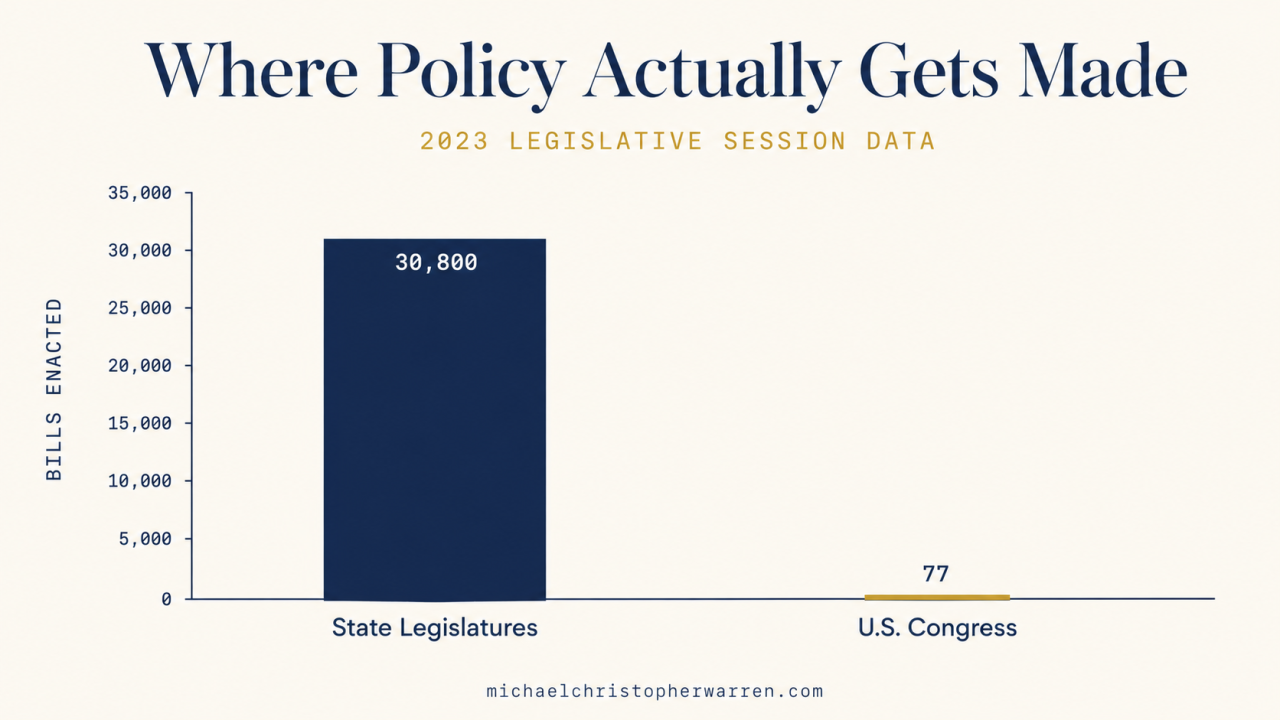
In 2023, state legislatures across the United States introduced more than 132,600 bills and enacted over 30,800 of them. In the same period, Congress introduced just over 10,300 bills and enacted 77. Congress had a 0.75 percent passage rate. State legislatures averaged 23 percent.
That is not a temporary imbalance. It is the operating reality of American policy-making — and it has been trending in this direction for long enough that the organizations still treating state legislative engagement as a supplement to their federal strategy are carrying significant unpriced risk.
75% of government affairs programs now target state legislatures as their primary focus, edging out federal engagement at 69.2%, according to the 2025 Quorum State of Government Affairs survey. That number will continue to shift as congressional gridlock persists and states continue filling the policy vacuum on healthcare, technology regulation, energy, data privacy, and employment law.
The organizations that have not restructured their government affairs investment to reflect this shift are not missing a trend. They are missing the primary venue where their operating conditions are being determined.
The challenge is not that organizations lack state legislative programs. Most organizations of any scale have some version of state legislative engagement — lobbyists retained in priority states, monitoring services tracking relevant bills, trade associations covering industry-wide issues.
The challenge is that most of those programs are built for reaction. They are designed to identify threats and mobilize against them. They are not designed to shape the environment before threats materialize — and in state legislative politics, by the time a threat is visible enough to mobilize against, the most effective moments for intervention have already passed.
Why State Legislative Strategy Is Different From Federal Advocacy
Practitioners who have spent their careers in federal government affairs often bring their federal instincts to state-level work — and consistently underperform because of it. The skills transfer. The tactics do not.
| Federal Advocacy | State Legislative Strategy | |
| SCALE | 535 members of Congress | 7,383 state legislators across 50 states |
| TIMELINE | Year-round sessions, perpetual calendar | 60-90 day sessions — the off-season is when the work happens |
| ACCESS | Highly competitive — staff is a gatekeeper | More accessible — direct legislator relationships are buildable |
| SPEED | Slow — the legislative calendar is forgiving | Fast — a 60-day session compresses everything |
| CONTAGION | Federal bills are contained | State bills spread — what passes in one state appears in adjacent states the following year |
The contagion dynamic is worth dwelling on. State legislative advocacy practitioners consistently see the same bills — data privacy frameworks, scope of practice changes, certificate of need modifications, energy mandate structures — appear in one state and migrate to adjacent states in the following session. The organization that engages on a bill when it appears in its home state is often already behind the organization that tracked the issue when it first appeared in another state and built its counter-argument before the bill was even drafted locally.
The Pre-Session Window — Where Most State Legislative Fights Are Actually Won
The most valuable period in the state legislative calendar is the one that most organizations treat as the off-season.
In states with 60-day sessions — which is a large share of the country — the session itself is a sprint. Bills move quickly through committees. Amendments happen overnight. Floor votes are scheduled with little warning. The organizations that win in a 60-day session are not the ones that are most responsive during those 60 days. They are the ones that spent the preceding months building the relationships, positioning the arguments, and cultivating the legislative champions that make the session a confirmation of work already done rather than a scramble to do the work in real time.
“The organizations that win in a 60-day session are not the most responsive during those 60 days. They are the ones who made the session a confirmation of work already done.”
What does pre-session positioning actually look like in practice? It is not mysterious. It is disciplined.
LEGISLATIVE LANDSCAPE MAPPING
Who chairs the committees relevant to your issues? Who are the bill sponsors most likely to carry friendly or hostile legislation? Who are the swing votes in committee on your priority issues? What is the majority leadership’s stated priority agenda for the coming session? Who in the minority has been effective at shaping the majority’s approach? This mapping should be complete before the session gavels in.
RELATIONSHIP INVENTORY
Which legislators already know your organization? Which ones have visited your facilities, met your employees, or engaged with your community programs? Which committee staffers have you briefed in the past twelve months? Which ones have you never met? The relationship inventory tells you where you are starting from and where the gaps are that need to be filled before the session starts.
CONSTITUENT ACTIVATION
Legislators are responsive to constituents. Your employees, customers, and community partners who live in a legislator’s district are constituents. Building and activating those connections — so that a constituent voice accompanies your advocacy conversations — is a pre-session activity. Organizations that try to activate constituents during a session are doing it too late. The relationships between your advocates and their legislators need to exist before anyone asks them to make a call.
ARGUMENT PREPARATION
What are your three strongest arguments for each of your priority issues? What are the three strongest arguments your opponents will make? What data, economic analysis, and constituent stories support your position? What does the legislative record in other states show about how similar bills have played out? Preparing the argument before the session means you are never improvising in a committee hearing. You are confirming positions you have already tested.
COALITION PRE-ASSEMBLY
Who else has interests aligned with your legislative priorities? Who needs the same outcome but comes from a different constituency — labor versus business, urban versus rural, healthcare versus industry? Building the coalition before the session means your legislative champions walk into hearings with multiple credible voices already aligned. Assembling the coalition after a bill drops means you are asking for favors instead of delivering support that was already committed.
The Legislative Relationship Framework — How Serious Practitioners Build State Capital Presence
There is a significant difference between having legislative relationships and having legislative presence. Relationships are transactional — they exist around specific asks. Presence is structural — it exists continuously, whether or not there is a specific ask, and it changes how legislators and their staff perceive your organization before any specific issue arises.
Building state capital presence requires a different cadence than most GR programs operate on. Here is what it actually requires.
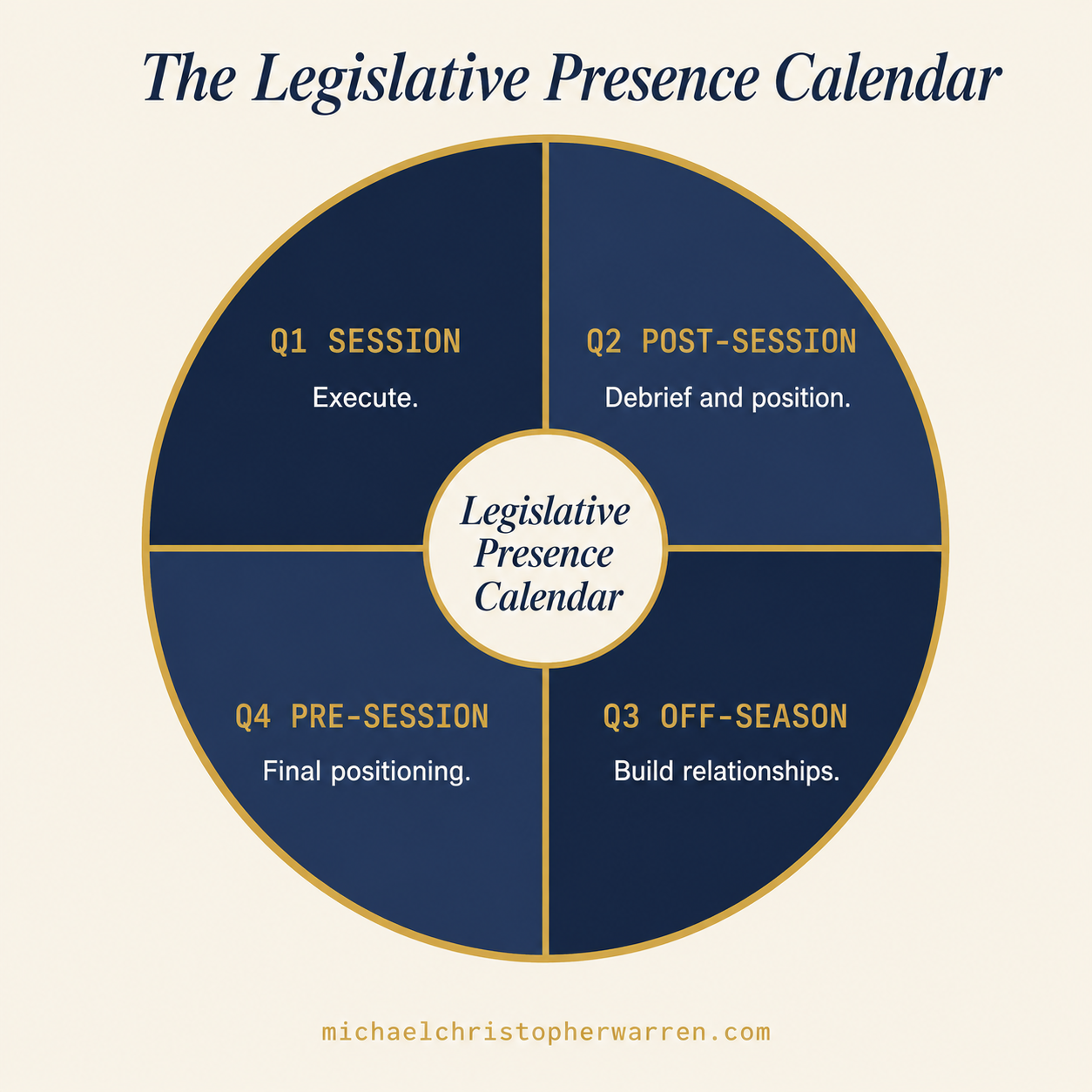
The Legislative Presence Calendar
Year-round engagement structured around the legislative calendar — not the crisis calendar
Session — Execute and Monitor
The session is in progress. Your job now is execution against a strategy that was already set. Track bills daily. Activate constituents and coalition partners as needed. Respond to committee schedules. Maintain daily contact with your lobbyists. Brief your organization’s leadership weekly. The quality of your Q1 execution is almost entirely a function of how well you prepared in Q3 and Q4 of the previous year.
Post-Session — Debrief and Position
The session has adjourned. Most organizations go quiet. The smart ones do not. Q2 is when you debrief — what worked, what did not, what issues are moving in adjacent states that will arrive in your state next year, what relationships need deepening before the next cycle begins. It is also when you begin building the case for next year — commissioning economic analysis, updating stakeholder briefing materials, and identifying early champions for priority issues.
Off-Season — Build Relationships
This is when relationship capital is actually built. Legislators are in their districts. They have time. They are accessible. Facility tours, community events, briefings on your organization’s economic impact, conversations about the issues they care about rather than the issues you care about — this is the work that makes the session easier. Organizations that only appear in the statehouse when the legislature is in session are perpetually explaining who they are rather than advancing what they need.
Pre-Session — Final Positioning
Pre-filing of legislation often happens in Q4. Bills are drafted. Committee assignments are being determined. Leadership priorities are being set. This is the last opportunity to shape what goes into the session before the session begins — to work with bill drafters, to secure co-sponsors, to brief committee chairs, to finalize the coalition alignment that will support your priorities when the gavel drops.
The Narrative Problem — Why Most State Legislative Arguments Fail
The most common failure mode in state legislative advocacy is not a failure of relationships or a failure of resources. It is a failure of narrative.
Organizations walk into legislative hearings and committee rooms with arguments that are well-constructed for their own internal logic but misaligned with how the legislators in those rooms are processing information. The argument that sounds compelling in a boardroom — sophisticated economic analysis, technical policy detail, regulatory precedent from other states — often lands flat in a committee hearing because it is speaking the organization’s language rather than the legislator’s.
State legislators are not policy experts. Most of them are part-time legislators with other professional lives. They are responsive to stories, constituents, and clear answers to the question they are actually asking — which is almost always some version of: how does this affect the people I represent, and what happens if I vote yes or no?
Before any legislative hearing, brief, or conversation, ask: what is the legislator actually worried about, and does my argument address that worry in language they use rather than language I use?
A legislator worried about job loss in their district is not persuaded by a discussion of regulatory cost structures. A legislator worried about constituent healthcare costs is not persuaded by a technical analysis of reimbursement methodology. The same underlying policy position can be argued in language that lands or in language that misses. The difference is whether you did the intelligence work to understand what the legislator actually cares about before you walked in the room.
The Three Arguments Every Legislator Responds To
Regardless of issue, industry, or political affiliation, state legislators consistently respond to three categories of argument. A state legislative strategy that cannot make a compelling case in all three is incomplete.
The Constituent Argument
How does this affect real people in this legislator’s district? Not in aggregate terms but in specific, named, human terms. Employees whose jobs depend on this policy. Patients whose care is affected. Families whose energy bills will change. Small business owners whose regulatory costs are at stake. The constituent argument is not anecdote as substitute for analysis. It is the human face that makes analysis politically real.
The Economic Argument
What is the economic impact on the district, the state, and the tax base? Jobs created or threatened. Tax revenue supported or jeopardized. Investment attracted or repelled. Capital deployed or withdrawn. State legislators are acutely sensitive to economic arguments because their constituents feel economic consequences directly — and because governors and legislative leaders use economic outcomes to judge the success of their sessions.
The Precedent Argument
What have other states done and what happened? State legislators are not operating in isolation — they are watching what their neighboring states and peer states are doing and they are sensitive to being either ahead of or behind where the policy consensus is moving. A bill that has passed in fifteen states with documented positive outcomes is a different argument than a bill that has stalled in ten states after significant industry opposition. The precedent argument gives legislators political cover and policy confidence simultaneously.
Intelligence Infrastructure for State Legislative Strategy
The intelligence challenge in state legislative strategy is scale. Fifty states, often running simultaneous sessions, with thousands of bills and dozens of relevant committees — no organization can track everything everywhere with depth. The organizations that have solved this problem have made deliberate choices about how to structure their intelligence infrastructure.
Tier 1 — Broad Monitoring (National)
Automated keyword and bill tracking across all 50 states to catch relevant legislation as it appears. Legislative tracking software handles this tier — FiscalNote, Quorum, MultiState, and others provide 50-state coverage. The goal is early warning, not deep analysis. When something appears in the broad monitor that is relevant, it moves to Tier 2.
Tier 2 — Priority State Intelligence (Regional)
Deep, primary-source intelligence on the five to ten states where your organization has the most significant exposure. In these states you are reading the committee hearing transcripts, monitoring the governor’s office communications, tracking the budget process, and maintaining a current map of the legislative landscape — who chairs what, who is running for higher office, which committee assignments changed after the last election. This is the intelligence that informs strategy, not just monitoring.
Tier 3 — Proceeding Intelligence (Specific)
For organizations with regulatory exposure alongside their legislative exposure — utilities, healthcare systems, energy developers, financial services firms — Tier 3 includes the commission proceeding intelligence that intersects with legislative strategy. What the PUC is doing in a rate case affects what the legislature considers on energy bills. What the insurance commissioner is doing in a rulemaking affects what the healthcare committee considers on scope of practice legislation. The practitioner who tracks both and understands their intersection holds structural advantage.
The Cross-Industry Application — Why This Framework Works Regardless of Sector
The state legislative strategy framework described in this guide is deliberately cross-industry. The specific issues change — certificate of need for healthcare, cost allocation for utilities, scope of practice for professional services, data privacy for technology companies. The underlying mechanics are identical.
A healthcare system navigating a certificate of need proceeding is doing the same pre-session positioning work as a utility navigating an energy mandate implementation bill. They are building the same kinds of legislative relationships, making the same three categories of argument, managing the same Q4 pre-filing dynamics. The issue vocabulary differs. The strategic architecture is the same.
This cross-industry consistency is why practitioners who develop genuine state legislative strategy expertise — as opposed to industry-specific policy expertise — are valuable across multiple sectors. The strategist who has run effective state legislative campaigns for a utility can apply the same framework to a technology company’s privacy legislation challenge or a healthcare system’s Medicaid budget fight. The mechanics transfer. The relationships and institutional knowledge accumulate and compound.
ENERGY / UTILITY
Clean energy mandate implementation, grid modernization cost recovery, data center load allocation, wildfire liability frameworks
HEALTHCARE
Certificate of Need, Medicaid reimbursement, scope of practice, price transparency, workforce legislation
TECHNOLOGY
Data privacy, AI regulation, digital services taxation, platform liability, workforce classification
FINANCIAL SERVICES
State banking regulation, insurance oversight, consumer lending legislation, fintech licensing frameworks
Where to Go From Here
State legislative strategy is a discipline built on a foundation of intelligence, relationships, and narrative — applied consistently over time on a calendar that most organizations have not yet restructured around. The organizations that win in state capitals consistently are not the ones with the most lobbyists or the biggest PACs. They are the ones who understand the terrain, built the relationships before they needed them, and show up every quarter — not just when the session is in and the fight is visible.
The framework described here is the architecture. Applying it requires intelligence infrastructure that gives you visibility into the legislative landscape in your priority states — which committees are moving which issues, which legislators are champions or opponents, what the opponent coalition looks like before they file an amendment.
For organizations navigating a specific state legislative challenge — a contested session, a market entry that requires state-level strategy, a healthcare system facing a CON proceeding, a technology company encountering its first state regulatory fight — the consulting engagements described here are the direct engagement model. For organizations with utility regulatory exposure alongside their legislative exposure, RegulatorIndex provides the intelligence layer that connects commission proceedings to legislative strategy.
Michael-Christopher Warren
Government affairs and external affairs professional. Founder of RegulatorIndex.com — a practitioner-built intelligence platform mapping every U.S. Public Utility Commission for the professionals who can’t afford secondhand analysis. He writes at michaelchristopherwarren.com and publishes PUC Watch, a bi-weekly intelligence briefing on U.S. utility regulation.
RegulatorIndex.com →