Government Affairs Career Path: What the Job Actually Requires.
The government affairs career path is one of the most competency-based in professional life. The job description asks for credentials and years. What hiring managers actually evaluate is judgment, intelligence, and the ability to operate in rooms where the stakes are high and the information is incomplete.
What the Job Description Says vs. What the Job Actually Is
A Director of Government Affairs at a major company carries a base salary ranging from $165,000 to $264,500, with a targeted bonus of 24% and total target cash that can approach $330,000 — real numbers from a recent Saint-Gobain posting. The job description for that role reads like most Director-level GR postings: develop and implement comprehensive government affairs strategy, build relationships with government officials, monitor legislative and regulatory developments, collaborate with executive leadership.
That job description is accurate. It is also almost completely useless as a map of what the job actually requires and what hiring managers are actually evaluating when they decide who to hire.
This guide is the practitioner’s translation — what the formal language actually means, what competencies the role genuinely requires, how the career path works from entry level through executive leadership, and what separates the candidates who get these roles from the ones who do not.
It is written for two audiences simultaneously: practitioners who want to navigate the career path more deliberately, and hiring managers who want to understand what they are actually trying to hire and how to evaluate it.
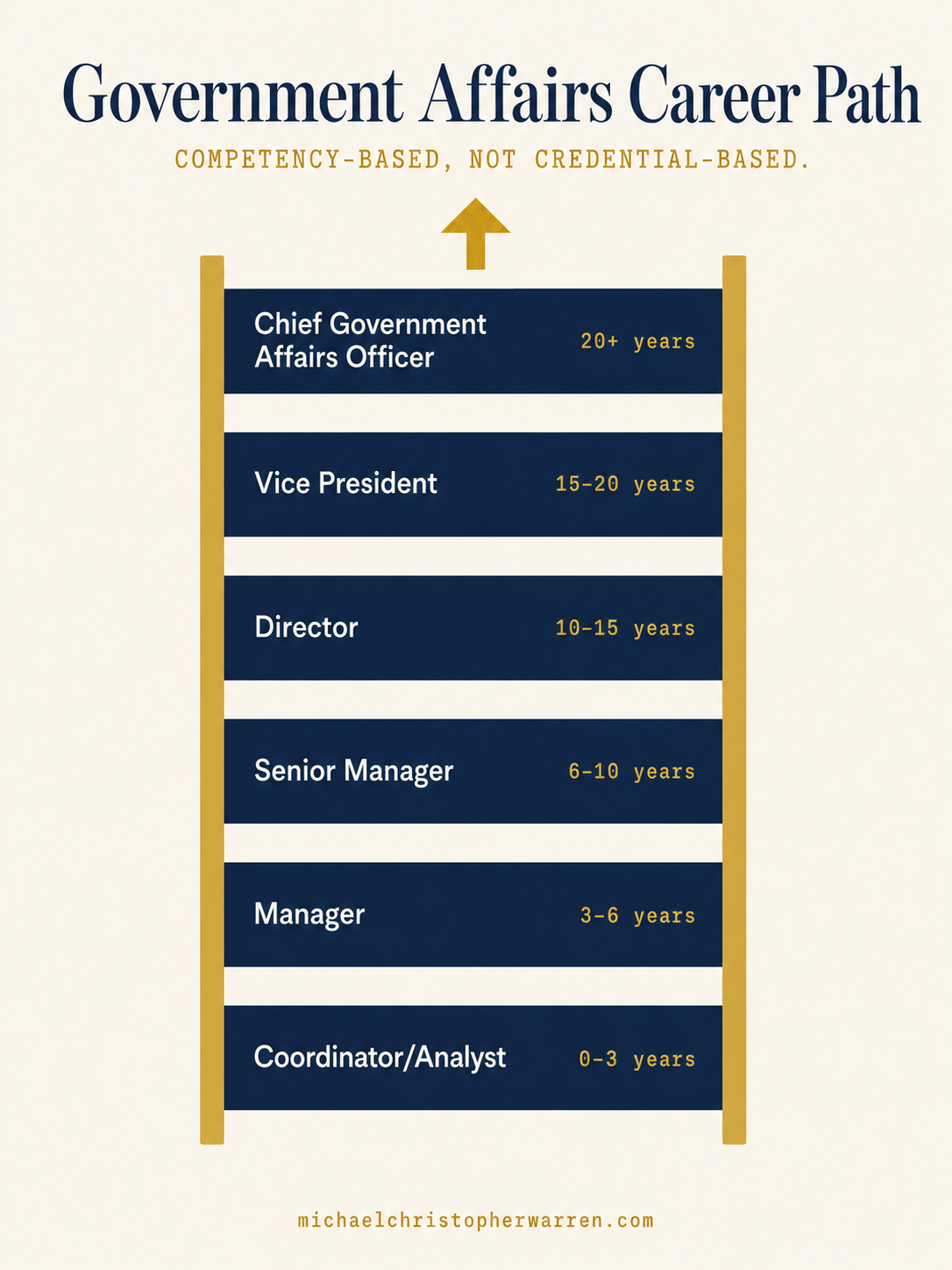
The Career Path — From Entry Level to Executive
The government affairs career path is more fluid than most professional tracks because the field draws practitioners from multiple backgrounds — policy, law, journalism, political campaigns, academia, and corporate functions that have adjacent skill sets. Understanding how the path typically works is useful context for practitioners at every stage.
Legislative tracking, research, briefing materials, scheduling, and administrative support for senior staff. The entry-level GR professional is learning how the system works — which committees matter, how bills move, what relationships look like in practice. The organizations that invest in entry-level practitioners at this stage by involving them in real meetings and real proceedings produce significantly stronger mid-level professionals than those who limit entry-level staff to research and administrative functions.
Managing specific issue areas, building and maintaining relationships with legislative staff and regulators, coordinating advocacy campaigns, contributing to strategy. The Manager role is where practitioners develop their own relationships and their own judgment — not executing someone else’s strategy but contributing meaningfully to its development. The transition from Analyst to Manager is primarily about relationship capital and strategic thinking.
Owning the strategy for specific geographies or issue areas, managing lobbyists and consultants, building and maintaining relationships at the senior government official level, advising executive leadership, and in some cases managing a team. The Director level is where the job becomes primarily strategic rather than operational — more time spent advising on what to do than executing what has been decided. Compensation at Director level typically ranges from $140,000 to $265,000 depending on organization and geography.
Leading the government affairs function across geographies and issue areas, representing the organization at the most senior government levels, integrating the GR strategy with business strategy, and managing a team of Directors and Managers. The VP level is where government affairs becomes a genuine C-suite adjacent function — advising the CEO on political risk, informing capital deployment decisions, and representing the organization’s interests at the level where consequential relationships are maintained year-round.
Chief Government Affairs Officer — the highest GR leadership role, sitting at the executive table and driving the organization’s policy vision, government engagement, and regulatory strategy as a core business function. At this level the distinction between government affairs strategy and business strategy has largely collapsed. The CGAO is not advising on the government affairs implications of business decisions. They are co-authoring them.
The Five Competencies That Actually Determine Who Gets Hired
Job descriptions for government affairs roles across every industry are remarkably consistent. They ask for the same things: legislative experience, regulatory knowledge, relationship-building skills, strategic thinking, and communication ability. These requirements are accurate but generic — they describe the surface of the role without capturing the specific competencies that distinguish practitioners who consistently produce outcomes from those who consistently produce activity.
Here are the five competencies that actually determine who gets hired at the Manager, Director, and VP level — translated from the formal language into what hiring managers are actually evaluating.
The Five Practitioner Competencies
What hiring managers are actually evaluating — translated from the job description language
Systems Intelligence — Reading How Power Actually Moves
The job description calls this “strong understanding of the legislative and regulatory process.” What it actually means is: can this person read a political situation correctly before it resolves? Can they identify who actually has power in a proceeding versus who merely has a title? Do they understand why a bill that has strong committee support might still fail on the floor, or why a commission order that looks negative in its summary might actually contain language that protects the organization’s long-term interests? This is systems intelligence — pattern recognition built from direct experience with how government actually operates.
Relationship Capital — The Asset That Cannot Be Manufactured Quickly
The job description calls this “proven ability to establish and maintain relationships with government officials.” What hiring managers are actually evaluating is whether the candidate has relationships that exist before there is anything to ask for — relationships where a legislative staffer will return a call without knowing what it is about, where a commissioner’s office will share informal feedback before a formal proceeding, where a governor’s policy advisor will flag something relevant unprompted. That kind of relationship capital is not built in months. The candidates who have it at the Director and VP level have been building it for years.
Strategic Translation — Connecting Government Affairs to Business Outcomes
The job description calls this “strategic thinking and problem solving.” What it actually means is: can this person translate government affairs intelligence into business-relevant terms that organizational leadership can act on? The practitioner who tells the CFO “we have a problem in the Virginia rate case” is doing less than one who says “the Virginia rate case outcome is creating a $40M cost recovery risk that affects the capital deployment decision you’re making in Q3.” Government affairs practitioners who can make this translation consistently become indispensable. Those who cannot remain perpetually undervalued.
Narrative Architecture — Constructing Arguments That Move Decision-Makers
The job description calls this “excellent written and verbal communication skills.” What hiring managers are actually evaluating is whether the candidate can construct an argument that is technically accurate, politically aligned with how the decision-maker is processing the issue, and delivered in language that the decision-maker uses rather than language the practitioner is comfortable with. This is not communication skill in the general sense. It is persuasion architecture — the ability to understand the specific frame a commissioner, a legislator, or an executive is using and build an argument that lands within that frame.
Intelligence Discipline — Operating From Primary Sources
This competency does not appear in most job descriptions — but it is one of the most reliable predictors of practitioner quality. Does this person read primary sources — actual commission orders, actual committee transcripts, actual legislative records — or do they operate from summaries and briefings? The practitioners who read primary sources hold asymmetric information advantage over those who do not. Over a career, this discipline compounds into a depth of institutional knowledge that is essentially impossible to replicate through any other means.
What Hiring Managers Are Actually Looking For — Behind the Job Description Language
This section is written for hiring managers. If you are a candidate, reading it is one of the most useful things you can do to prepare for an interview.
Most government affairs hiring processes are poorly designed to evaluate the competencies that actually predict performance. They rely on résumé review, a brief interview series, and references — none of which reliably surfaces systems intelligence, relationship capital quality, or narrative architecture skill. Here is what a more diagnostic hiring process looks like.
TO ASSESS SYSTEMS INTELLIGENCE
“Walk me through a regulatory or legislative situation where the formal record was telling one story and the actual dynamics were telling a different one. How did you read the gap and what did you do about it?”
What you are listening for: specificity. A candidate with genuine systems intelligence will describe a specific proceeding, specific signals, specific actors, and a specific strategic response. A candidate without it will speak in generalities about “reading the room” and “understanding the political dynamics.”
TO ASSESS RELATIONSHIP CAPITAL
“Name three relationships with government officials — legislators, commissioners, or agency staff — where the relationship exists outside of any specific ask, and tell me how you built each one.”
What you are listening for: whether the candidate can name specific people, describe specific interactions over time, and articulate why the relationship exists independent of transactional need. Generic descriptions of “building relationships” signal the candidate is describing an aspiration rather than a practice.
TO ASSESS STRATEGIC TRANSLATION
“Describe a time you had to advise organizational leadership on a government affairs situation where the recommendation was to do something counterintuitive or politically uncomfortable. How did you frame it and what happened?”
What you are listening for: whether the candidate has ever actually influenced a significant organizational decision, and whether they can describe their reasoning in terms that a CFO or CEO would recognize as strategically relevant. This separates advisors from reporters.
TO ASSESS NARRATIVE ARCHITECTURE
“You have fifteen minutes with a committee chair who is skeptical of your organization’s position. Walk me through how you would structure the conversation — not the arguments, the structure of the conversation.”
What you are listening for: whether the candidate starts by talking or starts by asking questions. The practitioner who starts by understanding what the chair actually cares about before making any argument has the instinct. The one who immediately leads with the organization’s talking points does not.
TO ASSESS INTELLIGENCE DISCIPLINE
“What was the most recent commission order or legislative committee transcript you read — not a summary, the actual primary source — and what did you take from it that a summary would not have given you?”
What you are listening for: whether the candidate can answer the question at all. A practitioner who regularly reads primary sources will have a specific answer immediately. A practitioner who does not will either dodge, generalize, or describe something they read about rather than something they actually read.
The Cross-Industry Reality — Why GR Competencies Transfer
One of the most underappreciated features of the government affairs career path is that the core competencies transfer across industries far more readily than most practitioners realize. The systems intelligence that makes a practitioner effective in utility regulation is the same systems intelligence that makes them effective in healthcare policy or technology regulation. The relationship capital built in energy policy circles is different from the relationship capital needed in financial services — but the method of building it is identical.
This transferability is what makes government affairs an unusually durable career path in a world of rapid industry disruption. The practitioner who develops genuine competency in the mechanics of government affairs — not just familiarity with a specific industry’s issues — is valuable across multiple sectors simultaneously. And the practitioner who has demonstrated that competency across more than one industry has differentiated themselves from the large majority of GR professionals who have spent their entire careers in a single sector.
The GR professional who has worked in energy, healthcare, and technology brings something to a Director role that a career specialist cannot replicate: pattern recognition across regulatory environments. They have seen how the same legislative dynamics play out differently across industries and they have developed the ability to apply frameworks from one context to solve problems in another.
In an environment where organizations in every industry are encountering state regulatory dynamics they have never faced before — technology companies navigating PUC proceedings, healthcare systems confronting energy cost pressures, financial services firms encountering state-level data regulation — the practitioner with cross-industry regulatory fluency is increasingly rare and increasingly valuable.
Building Your Government Affairs Career Path Deliberately
Most government affairs careers develop opportunistically — a political campaign leads to a legislative staff role, which leads to an industry association position, which leads to a corporate GR function. That path is fine. The practitioners who advance most consistently are the ones who layer deliberate discipline on top of whatever opportunistic path they are on.
READ PRIMARY SOURCES CONSISTENTLY
Commission orders, legislative transcripts, intervenor filings, agency guidance documents. Not every week on every issue — but systematically on the issues that matter for your current role and your intended next role. The practitioner who has read fifty commission orders in their career has a qualitatively different understanding of how commissions reason than one who has read zero. The gap compounds over time.
BUILD RELATIONSHIPS BEFORE YOU NEED THEM
The professional networking instinct in GR tends toward transactional — meeting people when you need something, following up when there is an immediate purpose. Invert this. The most valuable relationships in government affairs are built in the months and years before any specific ask exists. A legislator’s chief of staff who has met you twice in a non-urgent context and found you useful will take your call when something urgent materializes. The one who has only heard from you when you needed something will fit you into the category of supplicant rather than peer.
DEVELOP CROSS-INDUSTRY FLUENCY
Follow the significant commission proceedings and legislative fights in industries adjacent to your own. A GR professional in the utility space who understands what is happening in healthcare regulation and technology policy is significantly more valuable to a broad range of employers than one who only understands utility-specific issues. The investment is modest — subscribing to relevant intelligence, following key proceedings, attending a cross-industry conference annually. The differentiation it creates is meaningful.
PUBLISH YOUR THINKING
The government affairs field has very little public practitioner analysis. Most practitioners do not write. The ones who do — who publish analysis of commission proceedings, legislative dynamics, and regulatory trends — establish an authority signal that no résumé can replicate. A hiring manager at a company you want to work for who has read your analysis of their industry’s regulatory environment before you apply has already formed an opinion of you. Make it a favorable one by being right about something that matters to them.
The Intelligence Infrastructure That Accelerates the Career
The practitioners who advance along the governement affairs career path most consistently are not necessarily the ones with the best political connections or the most prestigious previous employers. They are the ones who have built the best information infrastructure — the monitoring systems, the primary source habits, and the institutional knowledge that allow them to operate ahead of events rather than behind them.
For practitioners with regulatory exposure — in energy, healthcare, finance, or any sector where commission proceedings affect operating conditions — RegulatorIndex provides the foundational intelligence layer that makes staying current on primary source intelligence operationally feasible. The platform maps every U.S. Public Utility Commission for the practitioners who understand that the intelligence advantage is the career advantage.
The Government Affairs Strategy pillar on this site covers the strategic framework that distinguishes intelligence-driven programs from reactive ones — directly applicable to practitioners building their own capabilities and to organizations assessing their GR function’s maturity. RegulatorIndex is the intelligence infrastructure that makes the primary source discipline described in this guide operationally feasible at scale.
Michael-Christopher Warren
Government affairs and external affairs professional. Founder of RegulatorIndex.com — a practitioner-built intelligence platform mapping every U.S. Public Utility Commission for the professionals who can’t afford secondhand analysis. He writes at michaelchristopherwarren.com and publishes PUC Watch, a bi-weekly intelligence briefing on U.S. utility regulation.
RegulatorIndex.com →