Government Affairs Careers
How to Hire a Government Affairs Manager Who Can Actually Build Power
Most government affairs hiring breaks before the interview. The organization has not defined the mandate. It has defined the vacancy — and those are not the same problem.
By Michael-Christopher Warren | RegulatorIndex.com
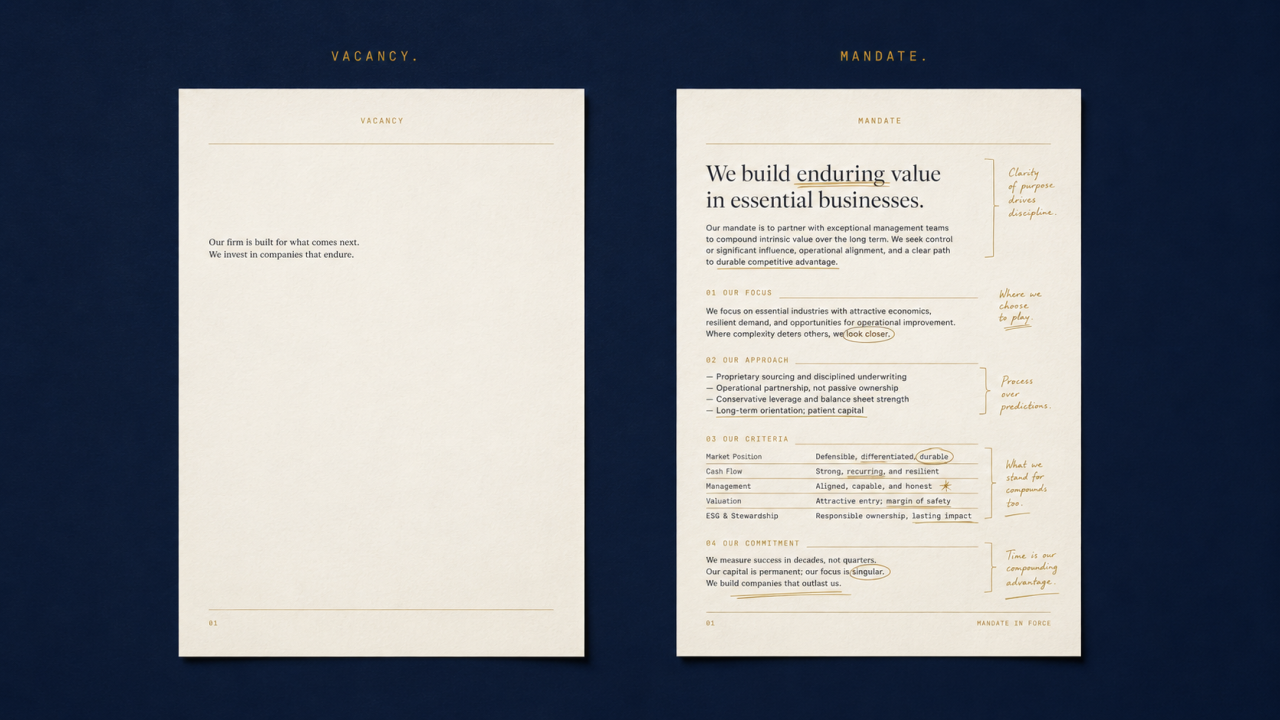
Knowing how to hire a government affairs manager who can actually build power starts well before the interview. Most organizations get it wrong earlier than they think.
They hire the wrong person earlier — when they write a vague mandate, overvalue tenure, confuse access with influence, and ask candidates to perform credibility instead of demonstrate judgment.
By the time the interviews begin, the process has already been shaped by the wrong questions. The posting attracted the wrong pool. The evaluation criteria reward the wrong signals. And the candidate who is best at performing credibility — who knows the names, references the relationships, and radiates government-adjacent authority — wins.
That candidate may or may not be able to build power. The process was never designed to find out.
The Core Distinction
Filling a vacancy is about relieving pressure. Defining a mandate is about building capacity. Most government affairs hiring is vacancy-filling dressed up as strategic hiring — and the process rewards whoever performs credibility best.
The fix is not a better interview. The fix is a better starting question.
Not: who should we hire for this role?
But: what problem does this role actually exist to solve?
If the organization cannot answer that question with specificity — naming the arena, the exposed business objective, the internal functions that need alignment, and the evidence that would show the hire is working — it is not ready to hire. It is ready to diagnose.
The Government Affairs Hiring Scorecard is that diagnostic.
MCW Framework
The Government Affairs Hiring Scorecard
The Scorecard is not a candidate-screening tool. That is the first thing to understand about it.
It is a mandate-definition tool. Its primary function is to force the organization to answer five questions it should have answered before anyone opened a job requisition. If those questions surface for the first time during candidate review, the process is already compromised.
Use the Scorecard internally before the posting goes live. If the leadership team cannot reach consensus on the answers, the function is not ready to hire — it is ready to align.
The Five Scorecard Questions
What outcomes must this person produce?
Not activities. Outcomes. There is a significant difference between “monitor state legislation” and “ensure the organization has a defensible position in the three jurisdictions where rate cases are most likely in the next eighteen months.” The first describes a task. The second describes a mandate.
If the team cannot write the outcome in one sentence, the mandate is not defined.
In which arenas will they operate?
Legislative, regulatory, executive-branch, local government, trade associations, community stakeholders — these are not interchangeable. A practitioner who is highly effective in a state legislative environment may have limited leverage in a federal regulatory proceeding. Arena determines the competency profile. Most job descriptions pretend every arena is equivalent. They are not.
Identify the primary arena first. Secondary arenas follow. Do not hire for all of them equally.
Which relationships actually matter?
Not which relationships sound impressive in a cover letter. Which relationships, in the specific jurisdictions and arenas that matter to this business, will determine whether the function can produce leverage. A name in a contact list attached to a former employer’s badge is not the same as a relationship that travels. The question forces the organization to be specific about geography, jurisdiction, and counterparty — not just “strong government relationships.”
Can this candidate name the three people who most need to know the organization — and show evidence the relationship already exists or can be built?
What internal functions must they influence?
Government affairs does not operate in a silo. The function has to move legal, communications, finance, and operational leadership in order to do its external job. A manager who cannot build internal credibility fast will be producing external activity with no organizational backing. This question forces the hiring team to think about internal political terrain, not just external relationships.
Does this candidate understand that the internal influence problem is as real as the external one?
What evidence would show they can do the work? — THE KILL SHOT
This is the question most government affairs hiring processes never answer. They substitute: did the candidate sound good in the room? Did they know names the hiring team recognized? Did they produce a comfortable impression? Evidence-based hiring is rare in this function because the field has always operated on credibility signals — and credibility signals are easy to perform and hard to verify. Question five interrupts that pattern. It demands actual proof: a work sample, a briefing, a demonstrated ability to read political risk and sequence stakeholders under time pressure.
If the hiring process cannot answer this question, it is not a hiring process. It is an audition for someone who is good at interviews.
“Evidence-based hiring is rare in government affairs because the field has always run on credibility signals. Credibility signals are easy to perform and hard to verify. Question five interrupts that pattern.”
M.C. Warren
Where Government Affairs Hiring Actually Breaks Down
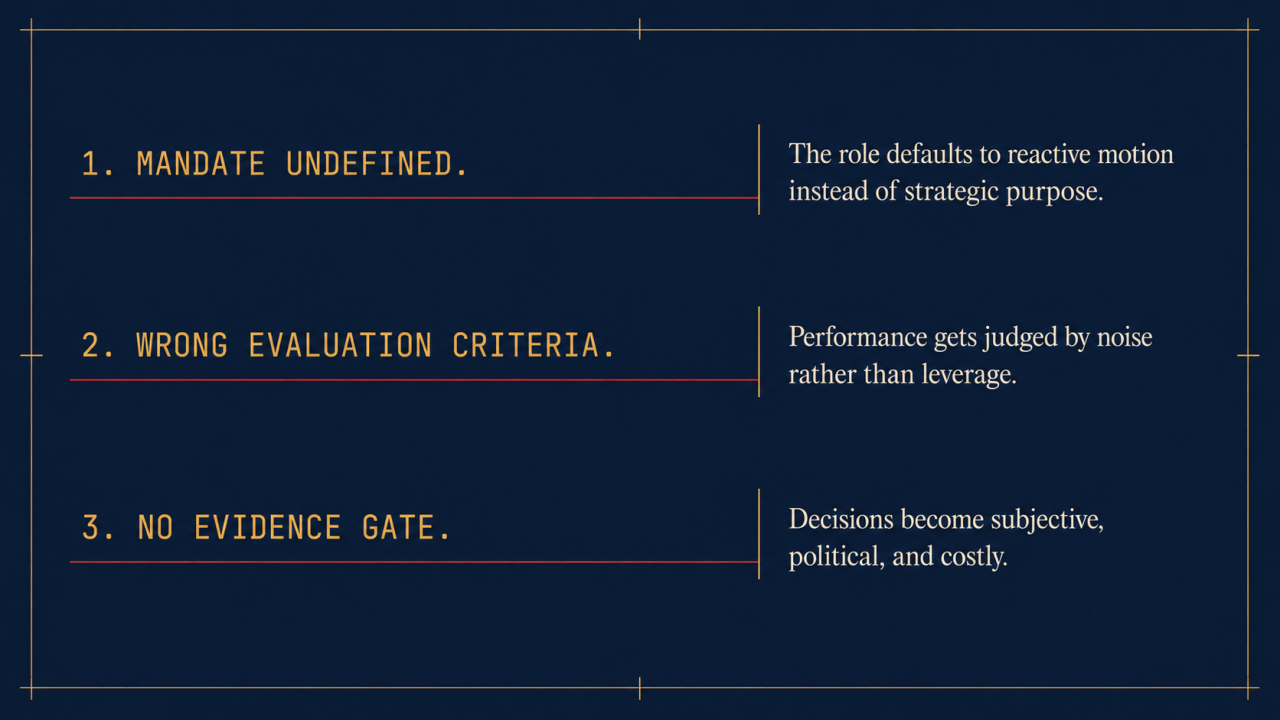
The Scorecard surfaces three failure points that most organizations discover only after the wrong hire is already in the seat.
Failure Point One: The Mandate Was Never Defined
The posting went live before anyone agreed on what the function was supposed to produce. Different stakeholders had different expectations — legal wanted a compliance buffer, communications wanted a coalition builder, the CEO wanted a relationship network, and the CFO wanted someone who could explain regulatory risk in business terms. None of those expectations were reconciled. The new hire walked into a function with four competing definitions of success and no way to win all four simultaneously.
This is not a hiring failure. It is a leadership alignment failure that shows up as a hiring outcome.
Failure Point Two: The Evaluation Criteria Rewarded the Wrong Signals
The hiring team used years of service, institutional affiliation, and relationship name-dropping as proxies for capability. Those are not capability signals. They are comfort signals. They tell the hiring team that the candidate has been in rooms that look familiar. They say nothing about whether the candidate can produce leverage in a room they have never been in before.
The practitioner who has spent fifteen years in the same operating lane, managing the same portfolio, briefing the same internal audience, has fifteen years of repetition. That repetition may have produced deep familiarity. It did not automatically produce judgment.
Judgment shows up differently. It shows up as a candidate who, in the first conversation, is already diagnosing the problem underneath the title — asking about the business model, the pressure points, the arena, the internal alignment challenges, and the timing. That candidate is not performing government affairs knowledge. They are demonstrating government affairs thinking.
Failure Point Three: The Process Had No Evidence Gate
The hiring process moved from resume review to interviews to references — and never asked the candidate to actually do anything resembling the job. The references confirmed that the candidate was competent, collegial, and dependable. Nobody asked whether the candidate could produce a decision-ready briefing, sequence stakeholders correctly under time pressure, or read a political environment before the organization had committed to a position.
The absence of an evidence gate is not an oversight. It is the default. Government affairs hiring has historically operated on impression, access, and institutional affiliation precisely because the function’s outputs are hard to measure. That difficulty is real. It is not an excuse to skip the work sample.
What the Hiring Conversation Should Actually Surface
A structured hiring conversation for a government affairs manager role should not begin with resume review. It should begin with a problem statement.
Tell the candidate what the organization is facing in plain terms — the arena, the exposure, the internal alignment challenge, the timing — and watch what happens. A strong candidate starts diagnosing immediately. A mediocre candidate starts narrating credentials.
The conversation should surface six things. Not in isolation. In sequence.
Judgment
Does the candidate make decisions, or do they describe decisions that were made? There is a difference between someone who has been in the room and someone who has shaped what happened in the room.
Sequencing
Can the candidate explain who moves first, second, and not at all — and why? Stakeholder order is not intuitive. It is a skill. A practitioner who sequences correctly produces leverage. One who does not produces activity.
Political Risk Reading
Can the candidate read the environment before the organization commits to a position? Not after the vote is scheduled. Before the vote is inevitable. Early warning is only useful if someone is calibrated to produce it.
Business Translation
Can the candidate explain a regulatory or legislative development in terms of what it costs, what it risks, and what the organization should do next — without requiring the executive to do the translation themselves? This is the competency that separates practitioners from administrators.
Restraint
Does the candidate know what not to do, and when not to move? Premature positioning is one of the most expensive mistakes a government affairs function makes. A practitioner who understands the cost of moving too early — and can explain why they held — is a different class of professional than one who confuses activity with progress.
Evidence of Actual Execution
Not what the candidate was part of. What they drove. The distinction matters and the follow-up question is always the same: what would not have happened if you had not been there?
The Work Sample That Separates the Field
After the conversation, one work sample prompt is enough to separate the field. The brief is deliberately simple:
Work Sample Prompt
“Prepare a two-page briefing for leadership on a state-level issue that could affect the business in the next twelve months. Identify the issue, the relevant stakeholders, the risk, your recommended first moves, and what leadership should avoid doing prematurely.”
The work sample is not a test of writing ability. It is a test of political risk reading and stakeholder sequencing in practice. A mediocre candidate produces a well-formatted summary of a policy issue. A strong candidate tells leadership who matters, in what order, what to avoid doing prematurely, and why the timing is what it is. The difference between those two outputs is the entire point of the exercise.
How to Hire a Government Affairs Manager: Using the Scorecard in Practice
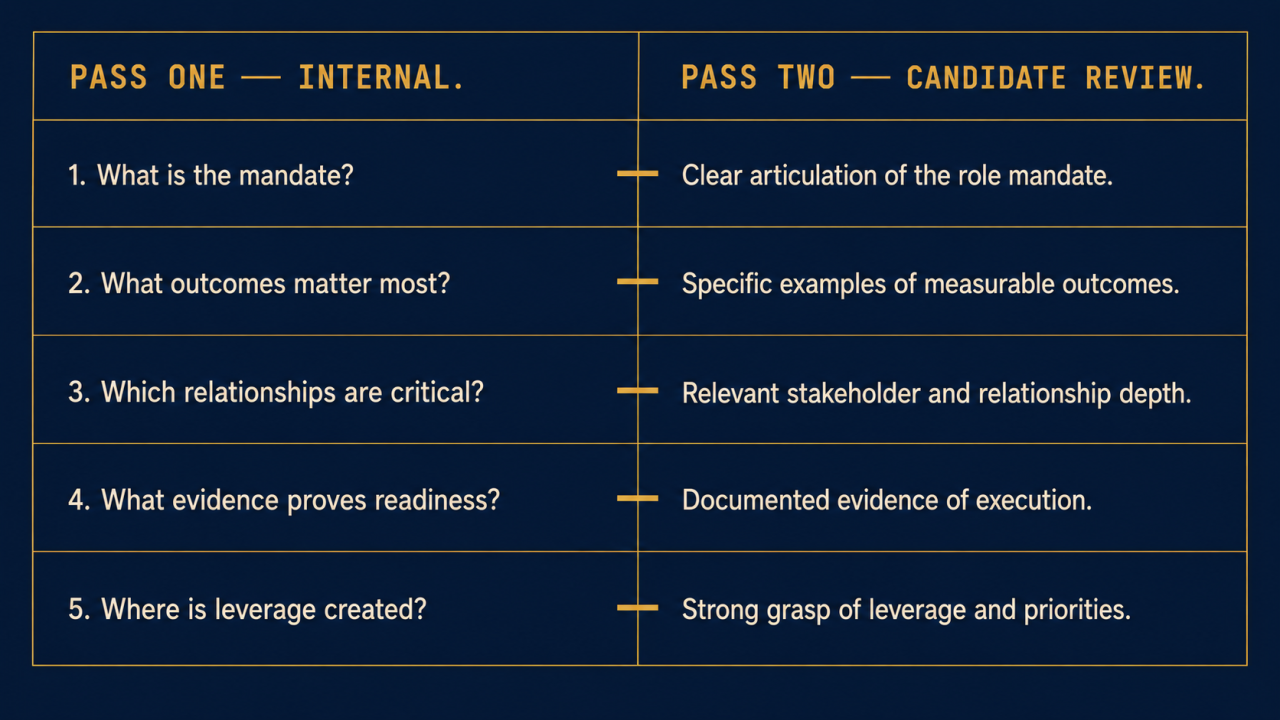
Run the Scorecard in two passes.
The first pass happens internally, before the posting goes live. The leadership team — whoever owns the government affairs function, plus the legal and communications leads who interface with it — answers all five questions independently, then compares answers. Disagreement is diagnostic. If the general counsel and the VP of External Affairs have materially different answers to question one, the mandate is not defined. The posting should wait.
The second pass happens during candidate review. Use the same five questions as an evaluation lens, not as interview questions to be read aloud. The answers should emerge from the conversation and the work sample — not from the candidate being prompted to describe themselves against a framework they have already read.
If the candidate can answer all five questions convincingly without being asked, they have diagnosed the role before the interview ended. That is the signal.
The Closing Practitioner Observation
The Government Affairs Hiring Scorecard is not a sophisticated tool. Its value is not complexity. Its value is that it forces a conversation that most organizations skip.
Most hiring processes in this function are built around making the organization feel confident that it hired someone credible. The Scorecard is built around something different: making the organization confident it hired someone capable.
Those are not the same standard. And the gap between them is where bad government affairs hires live — capable-seeming, credential-rich, relationship-adjacent practitioners who produce activity instead of positioning, meetings instead of leverage, and comfort instead of strategic advantage.
Define the mandate first. The organizations that figure out how to hire a government affairs manager correctly do not find better candidates. They ask better questions before the search begins. Run the Scorecard before the posting goes live. Put an evidence gate in the process. Ask the work sample question. And if a candidate walks into the first conversation already diagnosing the problem underneath the title — already asking about the business model, the arena, the exposure, the timing, and the internal alignment challenge — do not let them leave without understanding what you are building.
That is the hire.
“Most hiring processes are built to make the organization feel confident it hired someone credible. The Scorecard is built to make the organization confident it hired someone capable. Those are not the same standard.”
M.C. Warren
If You Cannot Answer the Five Questions
Do not post the role yet. Define the mandate first. That is the work my Tier 2 advisory engagement is built to do — scoped to the specific function, the specific arena, and the specific business exposure that makes this hire consequential.
View Engagement Options