Regulatory Intelligence | New York
Utility Government Affairs in New York Is Broken. Here Is What It Would Take to Fix It.
The PSC just cut Con Edison’s rate request by 87 percent. National Grid lost 67 percent. New York utility government affairs needs a new playbook. The problem is nobody has written it yet.
By Michael-Christopher Warren | RegulatorIndex.com
In January 2026, the New York Public Service Commission cut Con Edison’s electric rate request by 87 percent.
Not trimmed. Not negotiated down. Cut by nearly nine dollars out of every ten the company asked for.
National Grid had already absorbed a 67 percent cut to its upstate electric request the previous August.
The financial press covered the numbers. The trade press covered the proceedings. Nobody asked the more uncomfortable question: what does it mean when the regulator of the most complex utility market in the country is willing to reduce a $1.6 billion infrastructure request to $234 million in a single rate case order?
It means the old playbook is broken. And the companies that figure that out first will shape the next decade of New York energy policy. The ones that don’t will spend it reacting — to a socialist mayor who has made utility bills a campaign centerpiece, a legislature that is rewriting the state’s climate law in real time, a PSC that has been remade by five new commissioners in five years, and a data center industry that wants 11 gigawatts of new load and is not interested in paying for all of it.
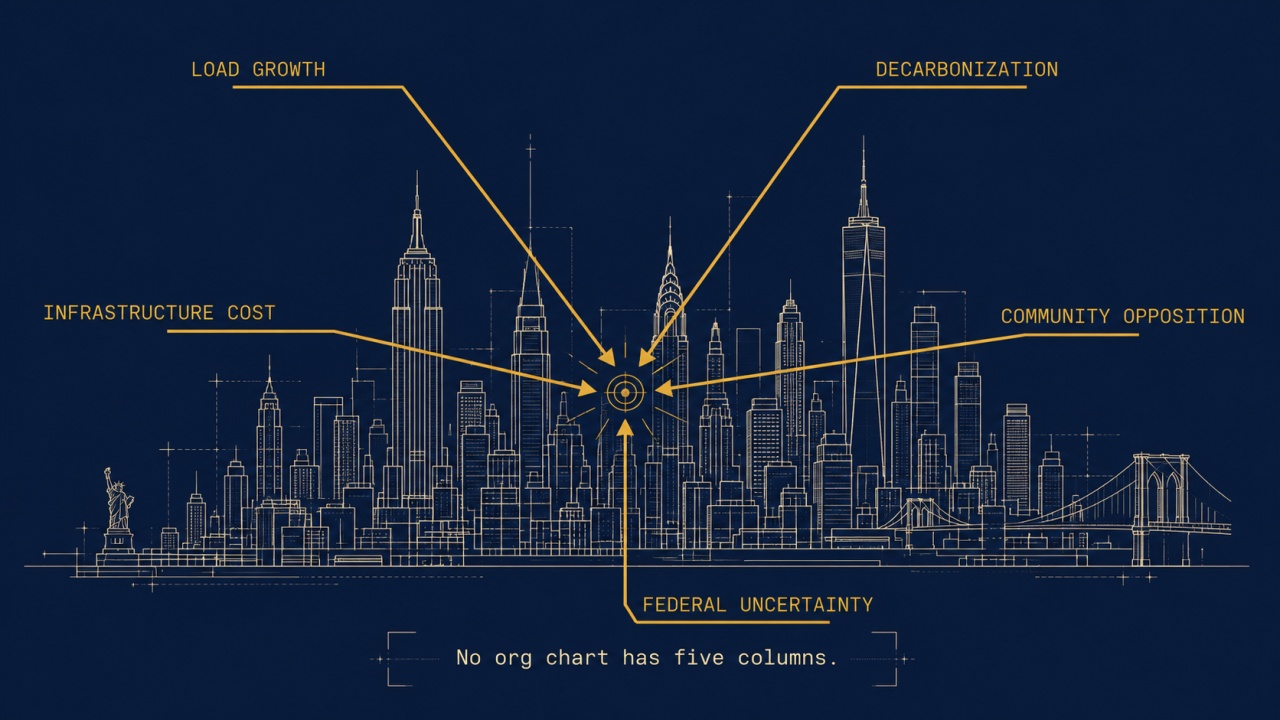
That is not a rate case problem. That is a five-front war.
And most utility government affairs functions in New York are not built for it.
The Core Diagnosis
New York utility government affairs is still organized around the Albany session cycle and the PSC rate case. The environment it is actually operating in requires a five-front simultaneous response that no existing org chart is built to deliver.
The Five Fronts No Single Strategy Can Manage
MCW Framework
The Five-Front War: New York Utility Government Affairs 2026
For a generation, New York utility government affairs operated on three parallel and largely independent tracks: an Albany team managing the legislative calendar, a regulatory team managing PSC proceedings, and a community and external affairs team managing borough presidents, city councils, and host municipalities. Trade association work ran on a fourth track. The tracks did not need to talk to each other because the threats they managed did not converge.
They converge now. All five of the following forces are cresting simultaneously, in the same 12 to 24 month window, against the same capital plans, the same rate cases, and the same political relationships.
Load Growth
As of January 2026, the NYISO interconnection queue contained 48 large-load projects totaling more than 11 gigawatts — up from six projects and one gigawatt in 2022. New buildings in Con Edison’s service territory are requesting 20 to 25 percent more power than comparable buildings built a decade ago. NYISO’s Power Trends report warned of reliability deficits in New York City as early as 2026. The grid is being asked to serve a demand surge it was not built for.
Decarbonization Mandates
The Climate Leadership and Community Protection Act requires 40 percent emissions reduction by 2030 and zero-emission electricity by 2040. As of January 2025, New York had reduced emissions by just 9 percent compared to 1990 levels — about a quarter of the way to the 2030 target. Governor Hochul announced in March 2026 that she intended to seek CLCPA amendments. Senate Finance Chair Liz Krueger and Environmental Conservation Chair Pete Harckham refused to negotiate. The law is simultaneously being rewritten and falling behind schedule — and the utilities are the ones who have to implement whatever version survives the fight.
Infrastructure Financing
Con Edison’s investor presentations project roughly $29 billion in five-year electrification capital expenditure. The PSC just approved a 9.4 percent authorized return on equity — below the national average — and cut the first-year electric request by 87 percent. The Commission is simultaneously demanding accelerated electrification and refusing to fund the capital plan that electrification requires. That is not a contradiction the utility can resolve in a rate case filing. It requires a political argument the company has not yet made publicly.
Community Opposition
The Westchester Municipal Consortium — 40 municipalities — intervened in Con Edison’s rate case for the first time and helped generate 20,000 public comments. National Grid’s 2019 Brooklyn-Queens-Long Island gas moratorium cost the company a $36 million penalty, an independent monitor, and a $7 million customer assistance fund — and permanently destroyed the political case for new downstate gas infrastructure. WE ACT, NY Renews, Public Power NY, and the DSA-aligned Build Public Renewables coalition collectively shape every CLCPA implementation decision. They are not going away.
Federal Policy Uncertainty
President Trump halted Empire Wind in April 2025 — later reversed — and destabilized NYISO’s 816 megawatt reliability assumption for 2027 in a single executive order. The Inflation Reduction Act tax credits NYPA is counting on for its Build Public Renewables buildout remain subject to congressional repeal. FERC’s Advanced Notice of Proposed Rulemaking on large-load interconnection directly affects how New York handles data center cost allocation. The federal floor has become a moving variable rather than a fixed constraint.
“No org chart has five columns. The companies that figure out how to fight on all five fronts simultaneously will shape the next decade of New York energy policy. The ones that don’t will spend it reacting.”
M.C. Warren
The Rate Case That Should Have Been a Warning
The January 2026 Con Edison rate order is the most under-read government affairs document produced in New York this year.
The headline number — an 87 percent cut to the first-year electric delivery request — is extraordinary enough. But the mechanism that produced it is more instructive than the result. Con Edison entered Case 25-E-0072 in January 2025 asking for an 18 percent base electric delivery increase. By April it had filed updated testimony seeking $1.6 billion. By December a 17-party joint proposal had reduced that to $234 million in year one.
Seventeen parties signed or did not oppose that joint proposal. The New York City Law Department. AMTRAK. Environmental Defense Fund. NY-GEO. Consumer advocates. Municipal governments.
The company filed an ask that the political environment could not sustain. Then it negotiated under maximum public pressure — 20,000 public comments, a White House meeting, a mayoral administration that had already told its constituents that utility affordability was a top priority. The outcome was not shaped by the regulatory record. It was shaped by the political environment that surrounded the regulatory record.
That is not a regulatory strategy. That is a regulatory accident.
87%
Con Edison Rate Cut
First-year electric delivery request reduced from $1.6 billion to $234 million. January 2026. Case 25-E-0072.
67%
National Grid Rate Cut
First-year upstate electric delivery request. August 2025. Same PSC. Same message.
20K
Public Comments Filed
In the Con Edison rate case. A political mobilization, not a regulatory proceeding.
11 GW
Large-Load Queue
NYISO interconnection requests as of January 2026. Up from 1 GW in 2022. Someone has to pay for it.
National Grid Has a Different Problem and It Is Worse
If Con Edison’s problem is rate case discipline, National Grid’s problem is existential positioning.
National Grid’s New York franchise is, in regulatory terms, a gas utility wrapped around an electric utility. And the gas business is on a statutory glide path toward obsolescence.
The 2019 Brooklyn-Queens-Long Island moratorium remains the defining government affairs case study in modern New York utility history. Imposed after National Grid could not demonstrate adequate gas supply to meet demand, the moratorium was lifted a year later under a settlement that included a $36 million penalty, an independent monitor, and a $7 million customer assistance fund. The independent monitor’s March 2021 report concluded the company had not remedied the organizational weaknesses that produced the problem in the first place.
What came out of that fight was something worse than a penalty: the permanent destruction of the political case for new downstate gas infrastructure. The Williams Pipeline — which would have resolved the supply constraint — is dead. The activist coalitions that killed it are still active.
Layer on the NY HEAT Act — sponsored by Senate Finance Chair Krueger, it would repeal the utility obligation to serve gas and cap residential energy bills at 6 percent of household income — and the Customer Savings and Reliability Act, a narrower successor that passed the Assembly on June 16, 2025. National Grid is being asked to invest billions in gas infrastructure under a statutory regime the legislature is actively dismantling.
Its August 2025 upstate rate plan allowed $1 billion in gas capital expenditure. That money sits on a regulatory faultline.
The PSC Nobody Is Lobbying

Five of the seven New York PSC commissioners have joined the bench since 2021. Most utility government affairs teams have not materially adjusted their approach to the commission since the appointments began.
That is a significant oversight.
Chair Rory Christian is a former engineer who went on to lead NRDC’s New York office and chair the board of WE ACT for Environmental Justice. Commissioner Uchenna Bright spent 13 years at NRDC before joining E2 as Northeast Lead. Commissioner Denise Sheehan was the DEC Commissioner who designed the Regional Greenhouse Gas Initiative. Commissioner Radina Valova is a national authority on interconnection process design who came from the Pace Energy and Climate Center and the Interstate Renewable Energy Council. Commissioner John Maggiore is a career Cuomo policy hand who understands Albany political dynamics.
This is not a commission that is philosophically hostile to utilities. It is a commission that is structurally skeptical of cost-of-service maximalism and structurally sympathetic to environmental justice framing — because three of its seven members built careers in organizations that have been counterparties to Con Edison and National Grid in contested proceedings.
A government affairs strategy built around explaining reliability needs to the Commission is misreading the room.
A strategy built around demonstrating how the capital plan affirmatively delivers CLCPA compliance, environmental justice benefits, and large-load cost insulation for residential customers is the only credible path. Those are different arguments. They require different preparation. They require different coalition support. And they cannot be assembled in the 90 days before a rate case filing.
| Commissioner | Prior Role | Strategic Implication for Utility GR |
|---|---|---|
| Rory Christian (Chair) | NRDC New York Director; WE ACT Board Chair | Every capital request needs an EJ co-benefit narrative. “Reliability” alone does not close the room. |
| Uchenna Bright | 13 years NRDC; E2 Northeast Lead; ORES Interim ED | Interconnection delays and clean energy integration are personal expertise. Don’t file cost-allocation arguments without modeling EJ community impact. |
| Denise Sheehan | DEC Commissioner; RGGI architect | Cap-and-invest design is institutional knowledge. Gas system arguments need transition-compatible framing or they will not survive her scrutiny. |
| Radina Valova | IREC Regulatory Program VP; Pace Energy & Climate Center | She will read the Energize NY Development proceeding at the technical level. Large-load cost-allocation arguments need to be technically airtight. |
| John Maggiore | Career Cuomo policy hand | Understands Albany political dynamics. The utility’s political narrative needs to be coherent enough to survive both the regulatory and legislative environment simultaneously. |
The Most Underpriced Political Risk in Con Edison’s Portfolio
In November 2025, President Trump sat across from then-mayoral candidate Zohran Mamdani at a White House meeting and said, publicly, that Con Edison “has to start lowering the rates.”
That sentence deserves more attention than it received.
A Democratic-socialist mayoral candidate and a Republican president found common ground on utility rate relief in the same room. Mamdani’s chief of staff had already told the Queens Daily Eagle that roughly a quarter of constituent calls to the office were about Con Edison utility bills. The Westchester Municipal Consortium was coordinating with municipal Democrats across the region. Senator Shelley Mayer’s office had covered the rate case as a political mobilization campaign.
The 2026 New York City Hall is not a customer service problem for Con Edison. It is a coordinated political adversary with a municipal franchise relationship — meaning the franchise agreement itself becomes a negotiating lever if the political pressure intensifies.
That is not hyperbole. That is the trajectory of a 2019-style moratorium situation before it becomes a moratorium.
The utility that treats City Hall as a stakeholder management problem rather than a political risk management problem will be six months behind when the risk materializes.
“A Democratic-socialist mayor and a Republican president found common ground on utility rate relief in the same room. The utility that treats City Hall as a stakeholder management problem will be six months behind when the risk materializes.”
M.C. Warren
The Data Center Cost-Allocation Fight Is Already Half-Lost
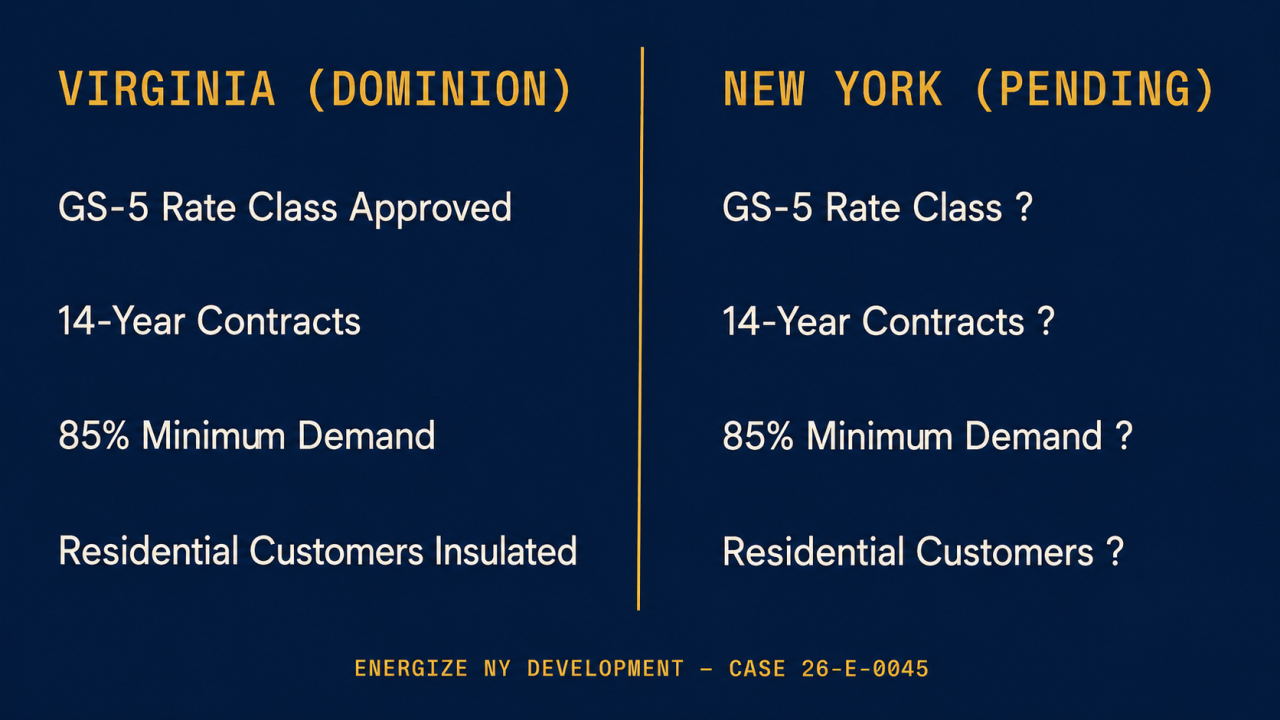
On February 12, 2026, the PSC instituted Case 26-E-0045 — “In the Matter to Address Interconnection Reforms for Large Loads” — under Governor Hochul’s Energize NY Development initiative. Chair Christian framed it with six words that should be required reading for every utility government affairs director in New York: “data centers pay their fair share.”
The proceeding will determine three things that matter enormously for utility revenue strategy: whether large loads must commit to firm capacity through long-term contracts, whether they pay directly for system upgrades or socialize the costs across the customer base, and whether utilities can offer differentiated tariff structures.
The template already exists. Virginia’s State Corporation Commission approved a GS-5 rate class for data centers requiring 14-year contracts with 85 percent minimum demand charges, effective January 1, 2027. The NY PSC is studying it. NRDC and Sierra Club cited it in joint comments. The New York version will be adapted, not invented from scratch.
Here is the strategic problem: Con Edison and National Grid have built their entire downstate growth narrative on the promise of data center, electrification, and reindustrialization load. If large loads are tariffed off with 14-year commitments and 85 percent minimums, some of that pipeline does not sign. If they are not tariffed correctly, the residential customer base absorbs the infrastructure cost — and the political coalition that produced 20,000 public comments in a rate case will produce 200,000 in the next one.
Dominion Energy solved this problem by proposing the large-load tariff itself before the SCC mandated one. The company owned the framework, shaped the terms, and emerged from the 2025 rate case with an approved cost-allocation structure that protected the residential customer base while keeping the data center pipeline intact.
New York utilities can do the same thing. But the window to move first is closing. A DPS staff white paper is due February 12, 2027. The utility that files a proactive large-load tariff proposal before that white paper lands will have shaped the conversation. The utility that waits will be responding to staff recommendations.
What Best-in-Class Utility Government Affairs Actually Looks Like
What Other Jurisdictions Are Doing That New York Is Not
The most useful frame for understanding where New York utility government affairs is falling short is to look at what comparable jurisdictions are doing that New York is not.
Dominion Energy in Virginia prosecuted a 12-month strategic narrative campaign before its 2025 biennial rate case. Rate increase requests were paired with a publicly proposed large-load rate class and a 14-year contract framework. The company socialized the bad news — load growth costs money, data centers should pay for their share — on its own terms. The result was an SCC order that gave Dominion much of what it needed on cost allocation while protecting residential customers. Dominion did not wait for the commission to propose a framework. It proposed one and defended it.
Pacific Gas and Electric and Southern California Edison maintain dedicated local public affairs structures embedded in geographic territory teams, with explicit responsibility for community intelligence and political risk validation. External affairs is not a function that assembles a coalition when a project faces opposition. It is a function that has already built the coalition before the project is announced. The difference is 18 months of relationship capital that shows up at a critical hearing as support instead of opposition.
Georgia Power has executed explicit contractual frameworks allocating cost responsibility to large loads. As of Q3 2025, 18 of 28 committed data center projects had broken ground. The utility built the load growth pipeline by building the cost-allocation framework first, not after the legislature asked.
What New York utilities are not doing:
Owning the affordability narrative. The NYSERDA cost memo — warning that full CLCPA compliance could impose $4,100 per year on upstate gas households — became the central document of the 2026 budget debate. Liz Krueger, Pete Harckham, the Business Council, NRDC, and Governor Hochul are all defining the affordability story. Con Edison and National Grid are not.
Building environmental justice political infrastructure. WE ACT, NY Renews, and Public Power NY collectively shape every CLCPA implementation decision. Utility participation is largely transactional — project-by-project mitigation payments — rather than structural. The utilities that will fare best in the next five years are the ones that have genuine co-design relationships with EJ communities before the next round of capital projects goes into the rate case record.
Integrating federal and state risk. Trump’s offshore wind halt, IRA repeal risk, and FERC’s large-load interconnection rulemaking all directly affect NYISO and the New York utilities. There is no visible utility government affairs structure in New York dedicated to federal-state policy integration at the level of sophistication this moment requires.
What the New Playbook Actually Looks Like
Strategic Framework
Three-Stage Restructuring: New York Utility Government Affairs
Stage 1
Restructure Now — Through Q3 2026
Stand up a dedicated Energize NY Development command team — cross-functional, including regulatory affairs, large-customer account management, federal affairs for FERC alignment, and external affairs. The comments due in Case 26-E-0045 are a strategic document, not a procedural filing. They will define what the DPS staff white paper says in February 2027.
Establish a CLCPA-amendment war room. The amendment fight is now a budget-cycle event for the next two state budgets minimum. Pre-position utility positions on cap-and-invest design, gas system transition, and EJ community benefit allocation before the legislature negotiates without you.
Assign a dedicated senior external affairs officer to the City Hall relationship — not a community liaison, a senior operator whose entire job is the Mamdani administration, the City Council Energy Committee, and the borough presidents. The trigger to escalate: any coordination between City Hall and Krueger’s office on a rate-relief bill.
Stage 2
Reframe the Capital Plan — Q4 2026 Through Q4 2027
Adopt a Virginia-style large-load tariff proposal unilaterally — before the PSC mandates one. Owning the framework is worth more than fighting it.
Build a public-facing affordability dashboard showing per-customer-class cost allocation transparently — what residential customers pay for versus what large loads pay for. Pre-empt the Krueger-Harckham-Mamdani narrative by owning the data before they do.
Restructure trade association engagement. Use AGA and EEI as defensive shields on federal issues only. State-level engagement in New York is now too politically idiosyncratic for trade narratives to land without utility-specific framing.
Stage 3
Build Coalition Capital — 2027 Through 2028
Direct partnership investments — not project mitigation payments — with WE ACT, NY Renews, and labor (IBEW Local 97, Local 1-2). A capital plan that has visible EJ co-design is harder for the Commission to cut. A capital plan that does not will keep producing 20,000 public comment campaigns.
Pilot publicly-coordinated projects with NYPA under the Build Public Renewables Act framework. The utilities cannot beat NYPA’s expanded authority in the Legislature. They can make it a partner by structuring co-developed projects in their territories. That is a better strategic position than adversarial posturing in a session where Albany is not going to side with the utility.
The Closing Practitioner Observation on Utility Government Affairs in New York
The three-stage framework above is not complicated. None of it is novel. Dominion figured out pieces of it. PG&E figured out other pieces. Georgia Power figured out the rest.
The complicated part in New York is organizational. A function that has been built around separate Albany, PSC, and community tracks does not naturally produce integrated responses to integrated threats. The incentive structure rewards managing your lane. The five-front environment punishes it.
The most underappreciated regulatory risk facing New York utilities in the next 18 months is not any single proceeding. It is the convergence: the Energize NY Development proceeding cresting in early 2027, the CLCPA amendment fight running through consecutive budget cycles, the Mamdani administration building its utility affordability agenda, and the next rate case filing already under preparation — all hitting simultaneously, all requiring coordinated responses, all making demands on the same relationships and the same political capital.
The utility government affairs function that is still organized for 2015 will not survive 2027 intact.
The one that restructures now — around the five fronts, around the commission as it actually is, around a political environment that includes both Mamdani and Trump as actors — has a real chance to shape the decade.
That is not a guarantee. But it is the only available path to something better than reacting.
“The utility government affairs function that is still organized for 2015 will not survive 2027 intact. The one that restructures now has a real chance to shape the decade. That is the only available path to something better than reacting.”
M.C. Warren
If Your Organization Is Navigating the New York Regulatory Environment
I work with companies at the intersection of regulatory intelligence and government affairs strategy. RegulatorIndex tracks every New York PSC commissioner, proceeding, and docket in real time. Engagements are scoped to the specific mandate and the specific arena.
View Engagement Options