Government Affairs Careers
Government Affairs Manager Job Description: What Companies Actually Need
Most job descriptions for this role sound respectable. The problem is they define it around the wrong kind of experience — and organizations pay for it long after the hire is made.
By Michael-Christopher Warren | RegulatorIndex.com
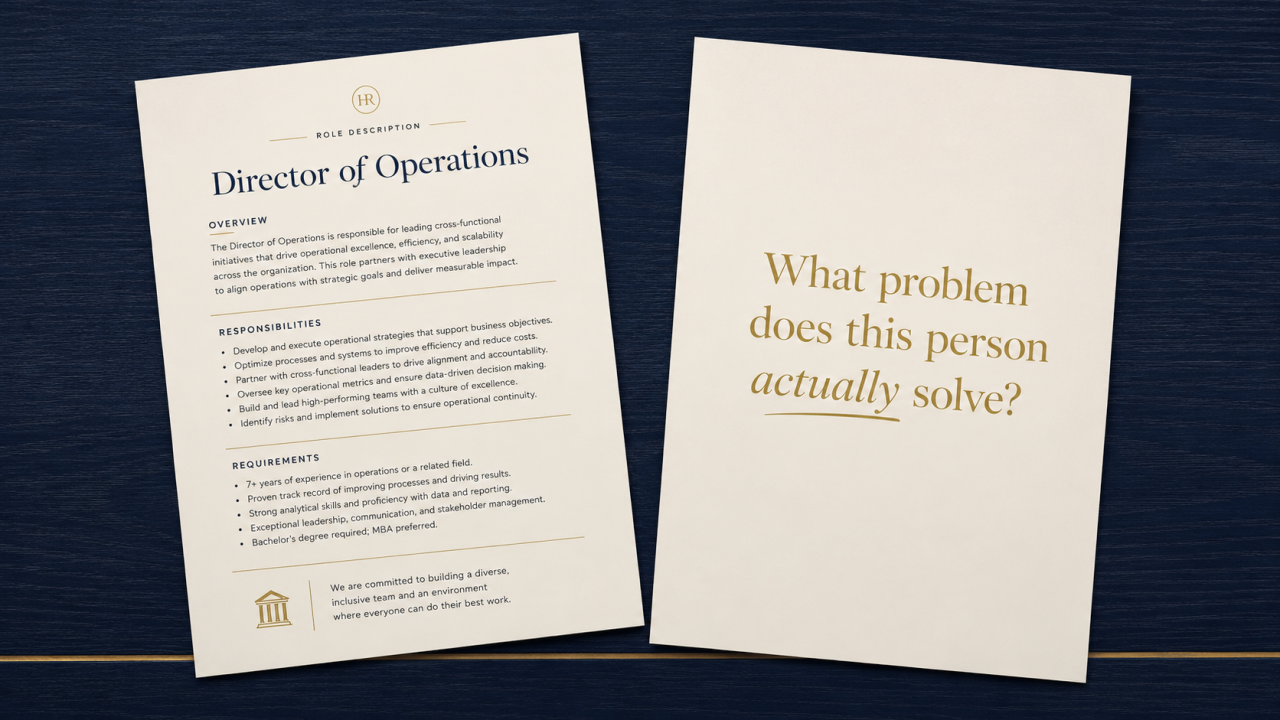
Most government affairs manager job descriptions sound respectable.
They ask for legislative monitoring, stakeholder engagement, policy analysis, relationship management, internal briefings, and experience working with public officials.
Nothing about that is wrong.
It is just incomplete.
The Core Diagnosis
Most organizations do not fail at hiring government affairs managers because they cannot find experienced candidates. They fail because they define the role around the wrong kind of experience.
The mistake is structural. Organizations write a job description that sounds sophisticated — someone with government experience, strong relationships, Hill background, trade association exposure, someone who can engage stakeholders and monitor legislation. But nobody has defined the actual mandate.
What problem is this person being hired to solve? Which arena matters most — the legislature, an agency, a regulator, the governor’s office, the attorney general, local officials, trade associations, community stakeholders? What business objective is actually exposed?
Without answering those questions first, the organization hires a resume that looks reassuring and gets a function that cannot produce leverage.
The Story Organizations Keep Living
Consider a scenario that plays out more often than anyone in the function admits.
A government affairs director needs to replace a manager who is retiring after decades in the role. On paper, a strong alternative candidate exists: someone who has built something from zero, understands how power moves in a complex environment, thinks strategically, and has direct experience inside the same government affairs function.
The director passes on that candidate.
The reason: not enough years in the title. The director is looking for someone who can say they have been doing government affairs for twenty years. What the director misses — because he lacks the evaluative framework to see it — is that twenty years of doing the same repeatable thing is not twenty years of experience. It is the same eighteen months of experience repeated a dozen times over.
And the relationships collected over those twenty years? Without the institutional backing of a major employer, most of them are names in a contact list. A relationship attached to a company badge is not the same as independent authority.
The candidate who gets the role will do what the previous person did. The function will produce what it always produced. And leadership will continue to wonder why government affairs never quite delivers the leverage they expected.
This is not an isolated story. It is the default pattern.
“Twenty years of doing the same repeatable job is not twenty years of experience. It is the same eighteen months of experience repeated. That may create familiarity. It does not automatically create judgment.”
M.C. Warren
What Happens After the Wrong Hire
The outcome is predictable. Activity goes up. Positioning does not.
Meetings happen. Tracking happens. Introductions happen. But leadership is still not seeing the issue early enough, internal teams are still not aligned around the real objective, and the company is still reacting after the moment has already hardened.
The real failure is not incompetence. Many of the people who get these roles know the institution very well. The problem is that institutional familiarity often gets mistaken for strategic capacity. And by the time leadership realizes the difference, the window on a legislative session, a regulatory proceeding, or a policy moment has already closed.
They hired for optics, access, and generalized government experience. What they needed was mandate clarity, business translation, and political risk reading.
What the Role Actually Exists to Do
A government affairs manager is not there to collect names, attend meetings, or keep an eye on policy.
The job is to convert legislative, regulatory, and political complexity into strategic advantage before the moment hardens against the business.
That is a different description of the same title. And the difference has consequences. It changes who you hire, what you measure, how you brief leadership, and when you move.
MCW Framework
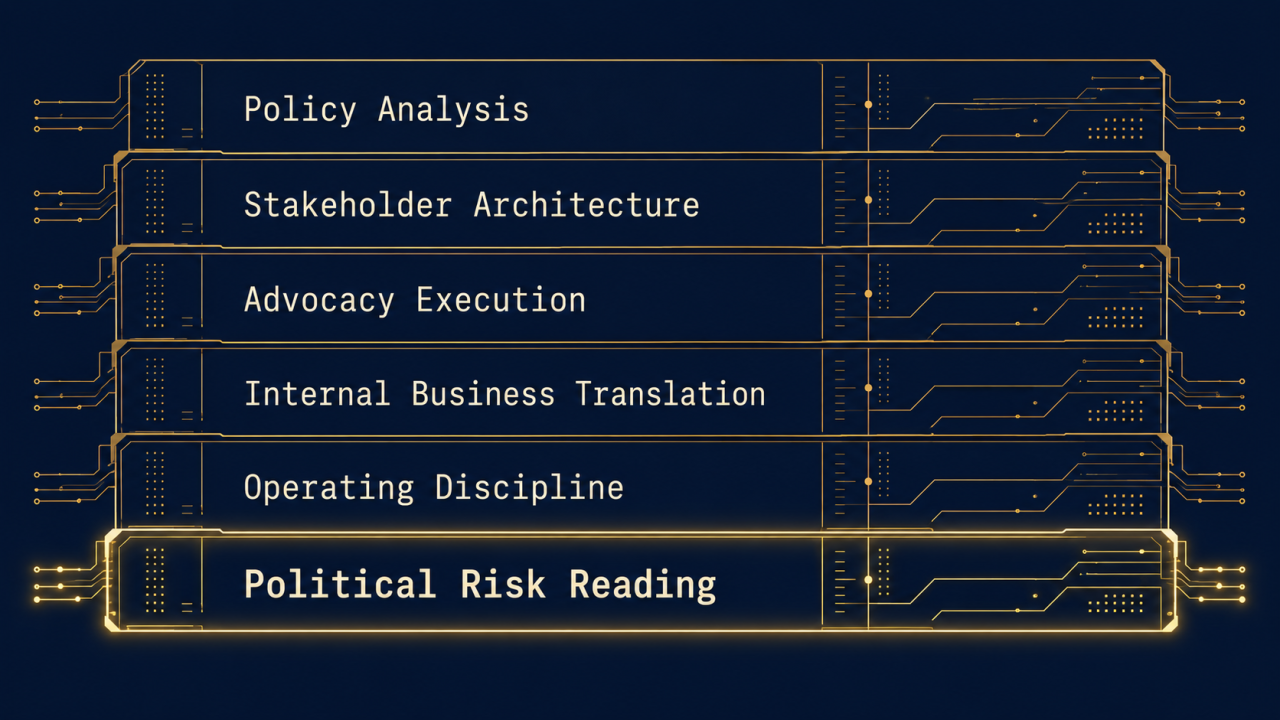
The Six-Layer Competency Stack
Most government affairs job descriptions identify some version of two or three of these. Strong hiring processes look for evidence of all six — and treat the sixth as the separator.
Policy Analysis
Reading and synthesizing legislative, regulatory, and policy developments with enough precision to distinguish signal from noise. Not just tracking. Understanding what a docket or bill actually means for the business.
Stakeholder Architecture
Mapping who matters, why they matter, and in what sequence. Not every stakeholder carries equal weight in every situation. A strong practitioner knows the order of operations before the organization has even started moving.
Advocacy Execution
Moving through the process with precision and timing. Knowing when to push, when to hold, when to let a coalition carry the weight, and when the window has closed. Execution at the wrong moment is indistinguishable from no execution at all.
Internal Business Translation
Converting external complexity into decision-ready guidance for leadership. This is where most government affairs managers lose the room. If the briefing requires the executive to do the translation work themselves, the briefing has failed.
Operating Discipline
The systems, cadence, and habits that keep the function running proactively instead of reactively. Most government affairs functions run on informal memory and personal relationships. That is fine until it is not.
Political Risk Reading — THE SEPARATOR
Assessing the political environment before committing the organization to a position. Reading the room before the room has formed. Most job descriptions do not name this explicitly. Most serious employers are hiring for it anyway — and most candidates cannot demonstrate it.
The Four Manager Archetypes
Government affairs manager is not a single archetype. The title covers at least four meaningfully different operating models. Understanding which one you actually need is the first step toward writing a job description that works.
| Archetype | Primary Arena | Core Competency | Typical Context |
|---|---|---|---|
| Front-Line Advocate | Legislative and regulatory direct engagement | Testimony, coalition work, direct lobbying | Fast-moving tech and innovation companies building presence |
| State Policy Operator | State-level relationship management and regional strategy | Multi-state regulatory engagement, governor relationships | Utilities, healthcare systems, financial services across multiple jurisdictions |
| Regulatory and Business Translator | Policy impact analysis and internal alignment | Commercial risk assessment, leadership briefing | Multinational companies navigating complex domestic regulatory exposure |
| Policy Operations Specialist | Internal tracking, analysis, and cross-functional support | Briefing systems, policy monitoring infrastructure | Large health systems, financial institutions with significant compliance adjacency |
Most job descriptions do not specify which archetype they need. They ask for all four. The result is a job description that looks comprehensive and actually says nothing — because it has not named the arena, the primary obligation, or the performance condition.
A front-line advocate and a policy operations specialist are not interchangeable. Hiring one when you need the other is an expensive mistake that takes eighteen months to diagnose.
What Strong Candidates Demonstrate Early
A genuinely strong government affairs manager candidate demonstrates judgment in the first conversation. Not experience. Judgment.
In the first conversation, they start diagnosing the problem underneath the title. They want to know how the business makes money, where the pressure is forming, who the real decision-makers are, what the timing looks like, and whether the actual arena is legislative, regulatory, executive-branch, local, or coalition-based.
They talk in sequence. They talk in tradeoffs. They can explain how they would read the political environment before committing the organization to a position.
What Mediocre Candidates Hide Behind
The mediocre candidate narrates a resume. They lead with names, access, and generic enthusiasm for policy. They tell you they know the Hill or have strong state relationships.
But listen closely and there is no architecture underneath it. No instinct for stakeholder order. No business translation. No signal that they can turn a messy external environment into a decision-ready recommendation for leadership.
A lot of government affairs directors and managers are coasting. Their superiors cannot tell the difference because they are using the wrong evaluation criteria — years of service, institutional affiliation, name recognition — instead of functional competency and demonstrated judgment.
Organizations are paying senior salaries for functions that are producing activity, not positioning. Most of them do not know it yet.
“If the briefing requires the executive to do the translation work themselves, the briefing has already failed.”
M.C. Warren
A Better Government Affairs Manager Job Description
The following is not a template to copy. It is a structure that forces the right questions before the posting goes live.
The goal is not a government affairs manager job description that looks professional. The goal is a description that attracts the person who can solve the actual problem — and makes every wrong candidate self-select out.
Sample Structure — Government Affairs Manager
The Mandate (define this first, before anything else)
This person will [specific outcome] in [specific arena] by [specific timeframe or condition]. The function currently [describe the gap or growth objective]. This role exists to close that gap.
Primary Responsibilities (ordered by strategic weight, not convention)
Lead the organization’s engagement with [specific agency / legislature / jurisdiction]. Translate external regulatory and legislative developments into decision-ready guidance for [specific internal audience]. Manage [specific relationship portfolio]. Build and maintain a [state / federal / local] presence strategy aligned to [specific business objective].
What We Are Actually Looking For
Evidence of political risk reading: can this person assess a political environment before the organization commits to a position? Demonstrated ability to sequence stakeholders correctly under time pressure. Track record of translating complex external developments into clear internal recommendations. Judgment over tenure. Relevant experience in [specific arena] over generic government affairs background.
The Question the Posting Should Answer
If your team read this description and could not say exactly what success looks like in year one, the description is not ready. Do not post it yet.
The Closing Practitioner Observation
If your organization cannot define the mandate, do not post the role yet.
Not because the role is not needed. Because you will hire the wrong person for the right need — and spend the next two years wondering why the function is not delivering leverage.
The government affairs manager job description is the first test of whether an organization understands what it is actually buying. Most fail that test quietly and expensively.
The ones that get it right define the problem before they write the posting. They know which arena matters. They know what success looks like in year one. They know they are hiring for judgment and political risk reading, not for an impressive list of former employers and known names.
That is a different kind of search. It finds different people. And it produces a different function.
If You Are Building This Function
If your organization is defining a government affairs mandate, assessing a current function, or building from scratch, I work with companies navigating that exact problem. Engagements are scoped to the specific need.
View Engagement Options