Government Affairs Careers
Director of Government Affairs: Strategy, Influence, and Execution
The director of government affairs is not a senior manager. It is a different job category entirely. Most organizations do not know the difference until the function stops producing leverage.
By Michael-Christopher Warren | RegulatorIndex.com
The director of government affairs job description is where most organizations make their most expensive and least visible mistake.
They promote their strongest government affairs manager into the director seat. The manager has performed well — reads legislation accurately, briefs leadership cleanly, manages relationships with discipline, handles a state issue with precision. The logic seems sound. Elevate the person who executes best and the function will scale.
Sometimes it does. More often, it does not.
Not because the promoted manager lacks capability. Because the director role is not a bigger version of the manager role. It is a different job category. And the distance between executing inside a function and owning a function is wider than most organizations recognize until the function stops producing what they need.
The Categorical Distinction
A government affairs manager executes inside the function. A director of government affairs designs, positions, defends, and scales the function. Those are not the same job at different pay grades. They are different jobs.
There is a related failure mode that surfaces specifically at the director level and is almost never named directly.
Some directors arrive with impressive networks built entirely inside a single institution — a mayor’s office, a regulatory agency, a legislative chamber, a trade association. They know everyone. They sit on boards. They are invited to rooms most practitioners never enter. On paper, the relationship portfolio looks extraordinary.
But two things are worth examining carefully before treating that network as a director-level asset.
The first: how were those relationships built? There is a meaningful difference between a practitioner who built relationships as a byproduct of judgment and execution over time — relationships that travel because the person earned them — and a practitioner who accumulated relationships because the institution was a relationship-production machine. Show up to the DC Mayor’s Office of Community Affairs for two decades and the city comes to you. That is the institution doing the work, not the practitioner.
The second: what happens when the environment requires something the institution never demanded? Twenty years in one operating lane does not produce strategic range. It produces deep groove familiarity with a single track. When the question changes — when technology intersects with regulation, when a new arena opens, when leadership asks for a strategic theory instead of a status update — the practitioner whose operating system was built for one environment and never updated will shut down. Not from lack of intelligence. From lack of altitude.
The director role demands altitude. Relationship depth is a necessary input. It is not a substitute for the strategic capacity the role actually requires.
What the Director Owns That a Manager Does Not
The manager’s job is to execute well inside a defined scope. Which issues to monitor, which relationships to develop, which briefings to produce, which advocacy moves to make — those decisions are largely set by the function’s existing operating parameters and the director above them.
The director’s job is to set those parameters. And then defend them — internally, to leadership that wants the function to chase every issue, and externally, to stakeholders who want the organization to take every position.
In practice, that means the director owns six things a manager does not.
Function Design
How the function is structured, what it monitors, which arenas it prioritizes, and how it interfaces with legal, communications, finance, and operations. The manager works inside this design. The director builds it.
Political Capital Allocation
Every organization has a finite amount of political capital — the trust, goodwill, and credibility it has accumulated with legislators, regulators, and other external decision-makers. The director decides where that capital is spent, where it is conserved, and which fights are not worth the cost of engagement.
Consultant and Vendor Strategy
Which lobbyists, law firms, coalition partners, and communications vendors are retained, managed, and held accountable — and against what strategic theory. A consultant roster without a governing strategy is an expense, not an asset.
Budget Ownership and Defense
Government affairs budgets are perennially under pressure because the function’s outputs are hard to quantify. The director must be able to defend the investment in enterprise terms — connecting expenditure to risk reduction, regulatory positioning, and strategic optionality.
Board and Executive Translation
Translating external regulatory, legislative, and political risk into language that allows the CEO, the general counsel, and the board to make decisions — not just receive updates. A director who briefs in policy language instead of enterprise consequence is not doing the job at the right altitude.
Maintenance Posture Detection
The director is responsible for ensuring the function does not quietly drift into a maintenance posture — executing the same repeatable activities, managing the same relationships, and producing the same updates — while the external environment shifts around it. A function in maintenance posture is not broken. It is just no longer producing strategic value.
MCW Framework
The Director Mandate
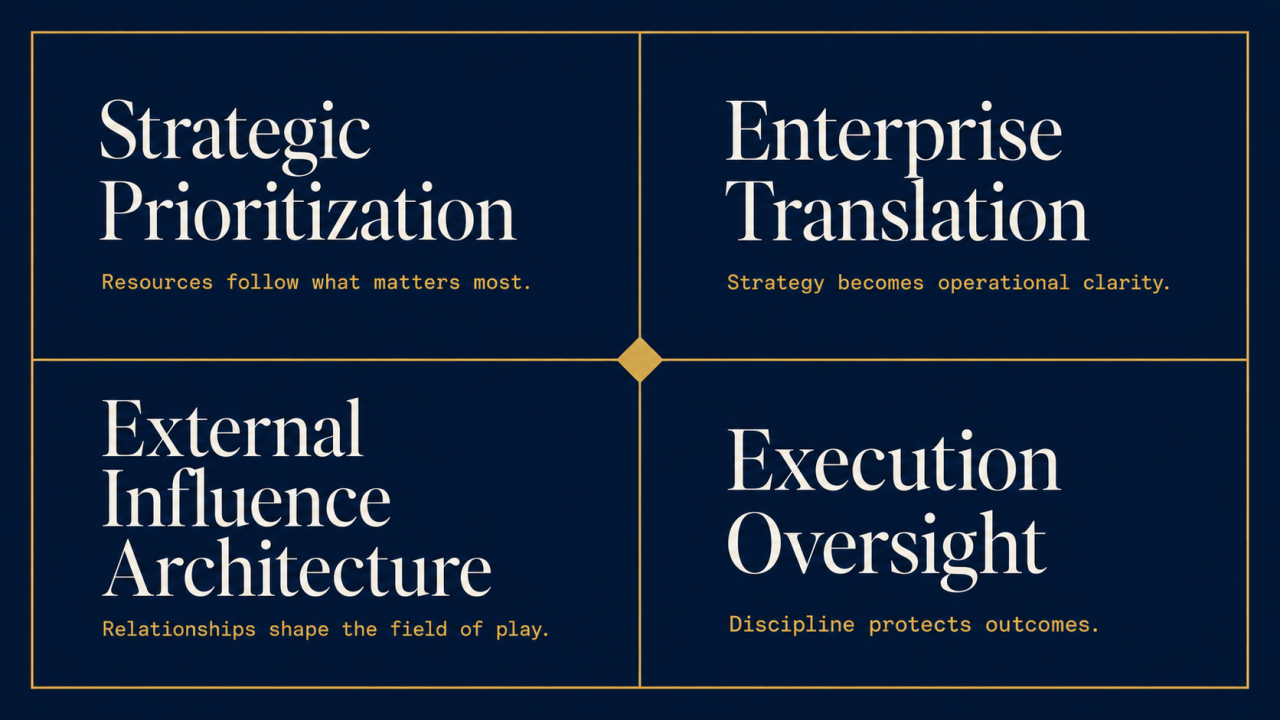
The Director Mandate is a four-pillar framework for what the director of government affairs role is actually accountable for producing. Not activities. Not relationships. Not legislative monitoring. Four strategic outputs that justify the function’s existence at the executive level.
Each pillar has a consequence architecture — what happens to the organization when that pillar is absent. That consequence architecture is more useful than the definition, because it is what executives actually experience when the director role is not working.
The Four Pillars of the Director of Government Affairs Mandate
I
Strategic Prioritization
Every department wants government affairs to chase its issue. Every trade association alert feels urgent. Every proposed bill becomes a fire drill. The director’s first job is to decide what actually matters — and what merely sounds important — and hold that line under organizational pressure.
Strategic prioritization is not about saying no. It is about allocating finite attention, relationships, and political capital against the issues that have real consequence for the business — and refusing to dilute that allocation because something generated internal noise.
Consequence When Absent
The function becomes busy, visible, and strategically irrelevant. It is present at every table and decisive at none.
II
Enterprise Translation
Government affairs speaks in policy language. Business leadership speaks in revenue, risk, operations, investment, timing, expansion, and reputation. The director’s job is to close that gap — not by simplifying the policy, but by translating its consequence into terms that allow leadership to make decisions.
A director who briefs the CEO on what a bill says is providing information. A director who briefs the CEO on what a bill costs, what it risks, what the timing is, and what the organization should do before the vote is scheduled — that director is providing enterprise value. Those are not the same briefing.
Consequence When Absent
Executives start treating government affairs as a reporting function instead of a decision function. The briefings become interesting. The function becomes optional.
III
External Influence Architecture
The organization may know people, attend events, sponsor tables, participate in coalitions, and maintain a lobbyist roster. But if there is no deliberate theory of influence — no stakeholder order, no map of who matters and when — the activity is not a strategy. It is a schedule.
External Influence Architecture is the director’s theory of how the organization builds and deploys external credibility over time. Which relationships need to exist before the crisis arrives. Which coalitions need to be built before the legislation is drafted. Which regulators need to know the organization’s position before the proceeding is opened.
Consequence When Absent
The organization has contacts but not leverage. It is known but not positioned. It reacts to external pressure instead of shaping it.
IV
Execution Oversight
The director does not execute every piece of government affairs work. The director ensures that consultants, internal team members, lobbyists, trade associations, and communications partners are all aligned around the same priorities, cadence, and accountability structure — and that the strategy survives contact with the people responsible for carrying it out.
Execution Oversight is not micromanagement. It is the discipline of ensuring that activity is connected to strategy — that what the lobbyist is doing in the capitol, what the manager is briefing internally, and what the coalition partner is communicating externally are all moving in the same direction at the same time.
Consequence When Absent
Everyone is active but nobody is accountable for movement. Strategy dies in meetings. The consultant roster becomes an expense the organization cannot defend.
What the Director of Government Affairs Hiring Conversation Should Surface
The hiring conversation for a director role is not a longer version of the manager conversation. The questions are different because the accountability is different.
At the manager level, the conversation surfaces execution capability — can this person read a bill, sequence stakeholders, brief leadership, and move through a process with precision and timing?
At the director level, the conversation surfaces function ownership — can this person design the function, allocate political capital, manage a consultant roster against a strategy, translate enterprise risk to a board, and hold a prioritization discipline when the organization wants to chase everything?
Six questions should anchor the director-level conversation.
How did you design the function you inherited or built — and what did you change first?
This surfaces function design instinct. A strong director can describe their theory of how the function should operate before naming what they did. A director who inherits a function and changes nothing has not taken ownership. They have taken the title.
Walk me through how you decided which issues to prioritize and which to let go.
Strategic prioritization is a discipline that produces friction. The director who has exercised it will remember the friction — which internal stakeholders pushed back, which trade association relationships became complicated, and how they held the line anyway. A director who cannot describe that friction has not actually prioritized. They have listed.
How did you brief your CEO or board on regulatory or legislative risk — and how did you know they were actually using the information to make decisions?
Enterprise Translation is the pillar most directors struggle with in practice, even when they understand it in theory. This question forces the candidate to describe a real instance of board-level translation — and to explain how they knew it was working. A director who cannot name a specific decision that changed because of how they framed an external risk has not been translating. They have been reporting.
How did you manage your consultant roster — and what was the governing strategy they were hired to execute?
Most directors can name their consultants. Fewer can articulate the theory of why those specific consultants were retained, what they were accountable for producing, and how the director evaluated whether they were earning their fees. A consultant roster without a governing strategy is an inherited expense the organization cannot defend.
Describe a moment when you told the organization not to engage — and why that was the right call.
Restraint at the director level is a strategic decision with political capital consequences. The director who has exercised it can explain the calculus: what the engagement would have cost, what holding preserved, and what would have happened if the organization had moved prematurely. This is the question that separates directors from operators.
When was the last time you changed your mind about a significant external risk — and what changed it?
A director operating at the right altitude is reading a changing environment in real time and updating their assessment when new information arrives. A director whose risk assessment never changes is not reading the environment. They are managing a position. This question reveals whether the candidate has intellectual range — or a groove.
How to Evaluate a Director of Government Affairs Already in the Seat
Most articles about the director of government affairs job description are written for job seekers or hiring managers filling a vacancy. This section is written for a different reader: the CEO, general counsel, chief of staff, or operating executive who already has a director in place and is trying to determine whether the function is producing what it should.
This is the evaluation that rarely happens formally — and should happen more often than it does.
The question is not whether the director is working hard. It is whether the director is operating at the right altitude.
Seven Questions for Executives Evaluating an Incumbent Director
Does leadership understand the organization’s top external risks because of this function — or despite the function’s absence from the conversation?
Is the government affairs agenda prioritized — or is it a list of issues that grows every quarter without a corresponding theory of what matters most?
Does the director translate political and regulatory risk into business consequence — or do the briefings require the executive to do the translation themselves?
Does the organization know which external relationships matter most and why — or is the relationship portfolio a function of where the director used to work?
Are consultants being managed against a strategy — or merely retained because they have always been retained?
Does the director shape internal decisions before external pressure becomes visible — or does government affairs arrive after the business has already committed to a position?
When the organization makes market-entry, investment, expansion, or operational decisions, is government affairs in the room early enough to matter?
If the answers to most of those questions are unfavorable, the function has likely drifted into a maintenance posture. Not broken. Not negligent. Just no longer operating at the altitude the director title implies.
A function in maintenance posture is executing the same repeatable activities, managing the same relationships, producing the same updates — while the external environment shifts around it. The director is busy. The function is visible. The organization is not better positioned because of it.
That is the most expensive version of the wrong hire. It costs more than a vacancy because it is invisible. A vacancy is a problem the organization can see. A maintenance posture director is a problem the organization has learned to work around — and stopped noticing.
“A vacancy is a problem the organization can see. A maintenance posture director is a problem the organization has learned to work around — and stopped noticing.”
M.C. Warren
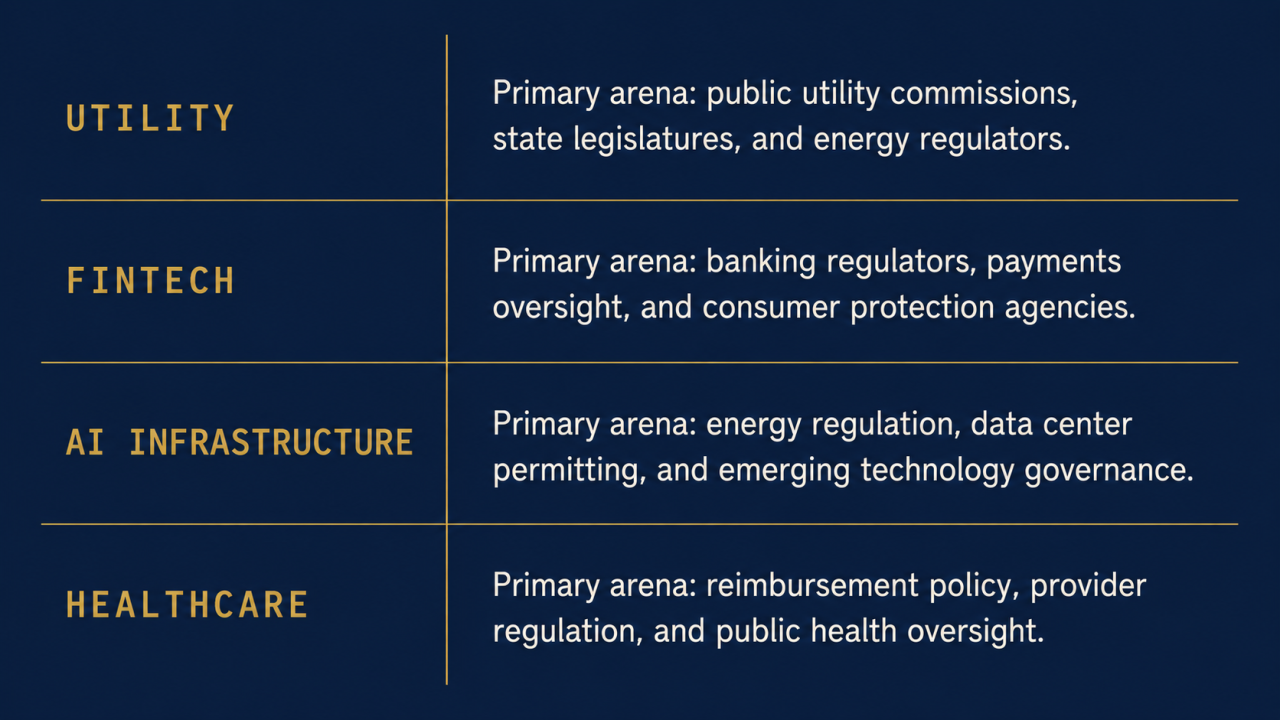
How the Director of Government Affairs Mandate Changes by Industry
The four pillars of the Director Mandate are constant. The arena, the risk profile, and the consequence architecture are not.
A director of government affairs at a utility is navigating rate cases, load growth, infrastructure credibility, community politics, and the intersection of energy policy with a regulatory commission that has direct authority over the business model. The External Influence Architecture looks like a map of commissioners, interveners, environmental advocates, and municipal officials.
A director at a fintech or challenger bank is navigating state-by-state licensing, consumer protection enforcement, banking partnership risk, and legislative perception in jurisdictions where the regulatory posture toward financial innovation ranges from permissive to hostile. The Enterprise Translation challenge is significant: most fintech executives underestimate regulatory exposure until it becomes enforcement.
A director at an AI infrastructure company is dealing with energy demand, data center siting, land use, economic development politics, state and local approval paths, and an emerging federal regulatory posture that is still being written. The function needs to be building before the rules exist — not reacting after they harden.
A director at an academic medical center or integrated health system is managing reimbursement exposure, state legislative relationships, hospital politics, community benefit obligations, workforce issues, and public trust across multiple stakeholders who do not share the same definition of the organization’s interests.
In each case, the Director Mandate applies. The specific expression of Strategic Prioritization, Enterprise Translation, External Influence Architecture, and Execution Oversight looks different — because the arena is different, the regulatory exposure is different, and the consequence of getting it wrong is different.
That industry-specific depth is where the function either earns its seat at the table or becomes a generalist advisory function with a large budget and a polite but limited role.
The Closing Practitioner Observation
The director of government affairs is not paid to be busy, connected, or politically fluent.
Those are inputs. They are necessary but not sufficient. A director who is all three and still cannot prioritize the function, translate risk into enterprise consequence, design an influence architecture, or hold a consultant roster accountable to a strategy is operating at the wrong altitude — and the organization is paying a senior salary for a senior-seeming maintenance function.
The director is paid to make the organization harder to surprise.
That is the mandate. Not monitoring. Not relationship management. Not stakeholder engagement. Not policy fluency.
Hard to surprise. Before the legislation is drafted. Before the regulatory proceeding is opened. Before the political environment has hardened against the organization’s position. Before the competitor has shaped the narrative and the organization is left reacting.
That is what a director-level government affairs function is supposed to produce for the enterprise. And that is the standard against which the hire — and the incumbent — should be measured.
“The director of government affairs is paid to make the organization harder to surprise. That is the mandate. Everything else is activity.”
M.C. Warren
If Your Function Is Not Operating at This Altitude
Whether you are evaluating an incumbent function, defining a director-level mandate, or building a government affairs capability from the ground up, I work with organizations navigating that specific problem. Engagements are scoped to the mandate, the arena, and the enterprise exposure that makes the work consequential.
View Engagement Options